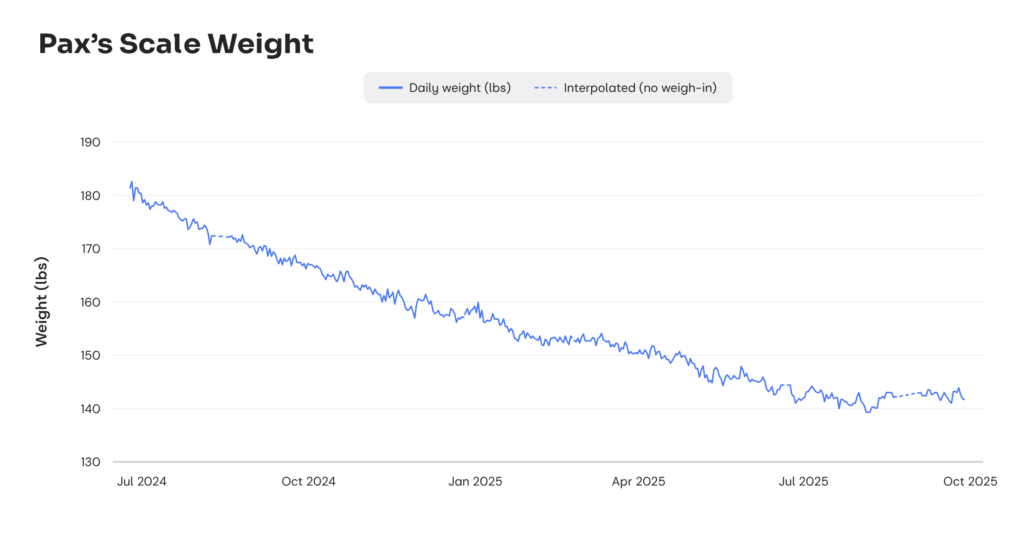
When Pax started coaching in June 2024, she weighed 181.4 lb. Thirteen months later, her weight had dropped to 142 lb, her waist was 5.5 inches smaller, and she’d gone from a size 12 to a size 4.
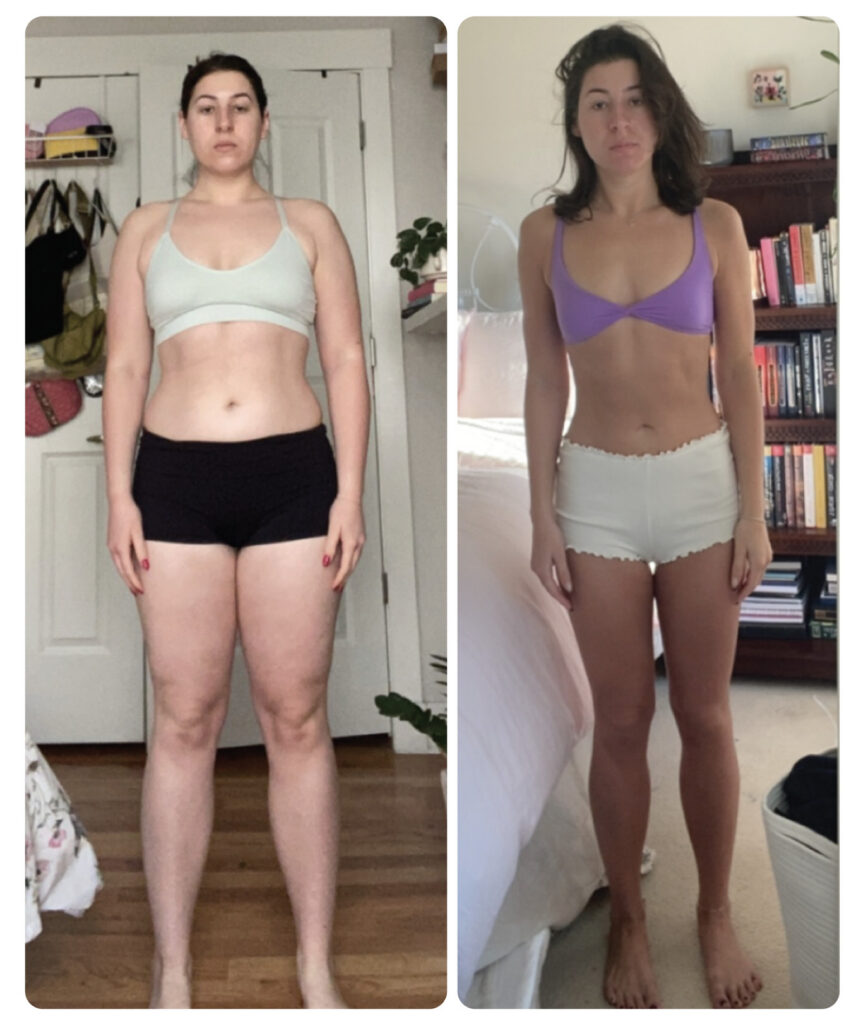
More importantly, she learned to navigate situations that used to disrupt her progress: eating out, vacations, and times when progress felt stalled despite her best efforts.
Here’s how coaching helped Pax reach her goal while building healthier habits along the way.
Knowing what to do isn’t the same as doing it
Pax wasn’t a beginner to fat loss. She knew how to track calories, understood macros, and followed her own strength-training routine.
But Pax wasn’t making the progress she wanted. Like most people who have made progress on their own, she wasn’t entirely convinced she needed coaching.
I hesitated because I had already lost weight on my own; I knew how to track calories and how to eat healthy, but I struggled with certain areas like eating out and sometimes the accountability.
As I explained to Pax, this isn’t necessarily a “knowledge” problem—she was too close to her own progress to be objective. Was her progress actually stalled, or was she seeing normal fluctuations from shifts in water or glycogen? If it was stalled, how much of a calorie reduction made sense?
Those questions might seem easy to answer, but making the right adjustments at the right time is harder than people realize, especially when you’re already frustrated or annoyed with your own progress.
Even if you can stay objective, it takes ongoing effort to review the numbers and decide what to change, when, and by how much (which is why coaches who know all this often hire another coach to manage their diet and training when they’re trying to get really lean).
That’s where a coach comes in: making those decisions objectively and laying out a weekly plan that gets the client out of their own way so they can make progress without the self-doubt.
Navigating social meals
One challenge Pax faced was navigating social meals while staying on track with her nutrition. Tracking felt like too much to manage, especially when she couldn’t be sure how accurate it would be, so she didn’t even bother trying.
And Pax isn’t alone in this. Many people think, “If I can’t track accurately, what’s the point?” But tracking meals out can still be useful, even when it isn’t precise.
Assuming the goal is fat loss, the first reason to track when eating out is that it makes you more mindful of your food choices. For example, you might review the menu and choose a healthier (or lower-calorie) option. You might skip or share dessert, or choose a different appetizer because you know you’re trying to manage your food intake. So even if the recorded intake isn’t super accurate, it still makes you more mindful of your food choices, which can reduce how much you would have eaten otherwise.
Second, inaccurate numbers still have utility. If your progress has slowed and you’ve been estimating when you go out to eat, you have somewhere to focus on. For example, your scale weight might decrease during the week and then fluctuate over the weekend. If this happens consistently enough to stall your progress, you can tighten up the weekends and see how that affects it.
One goal of nutrition tracking is to increase awareness around your current eating habits, and you don’t need “perfect” tracking to reap that benefit.
In Pax’s case, we had some strategies in place to help her track meals out. For example, she looked up the restaurant menu ahead of time and decided what she would eat. If that wasn’t an option, she could estimate the meal using similar items from another restaurant. I also asked her to “budget” for meals out in advance. If she knew she was going out on Saturday, reducing her intake by just 100 calories a day from Sunday to Friday would give her an extra 600 calories to work with.
The expectation wasn’t that she would suddenly track restaurant meals perfectly, but to build the habit of tracking when eating out so we had something to work with.
After trying these strategies for the first time, she realized it wasn’t as impossible as she previously thought. As Pax later told me:
I definitely focus on consistency and just continuing to put effort towards my goals and not get derailed by holidays or outside events. There’s always a way to troubleshoot an issue and tweak here and there to be more efficient.
Knowing when to change calories, and when to hold them
A big part of coaching is helping the client see the bigger picture, and stopping them from making decisions based on an overreaction to “noise” in the data.
On many occasions, Pax expressed frustration with scale fluctuations despite adhering to the plan.
“I feel like my weight should be lower than what it is and I’m starting to feel frustrated,” she once wrote in her tracker. When we checked in later that week, she said, “I’m actually so confused with my weight right now. I had more sodium than usual last night, so I guess that could be it. Trying not to get upset but it’s frustrating.”
But I explained to Pax that focusing only on these scale fluctuations, without considering the longer-term trend, can make you think progress isn’t happening even when it is. This overreaction to noise can lead people to cut calories too soon or add more exercise, which can hurt adherence down the line.
Looking at her longer-term trend, she was down to 168.1 lb—her lowest trend weight since we started coaching—and her weekly rate of loss was just a little over a pound per week, which was within our target range. In other words, the plan was working, and we didn’t need to change anything.
As Pax later explained:
I have a tendency to doubt myself so having another person to validate my experience or talk me out of my doubt was really great.
Taking a break while maintaining progress
I want clients to get comfortable with eating at maintenance. After all, losing fat is only a small part of the process—the ultimate goal is to maintain that progress once the cut ends. So while diet breaks may not do much for fat loss, they’re a useful way for clients to “practice” maintenance during the diet.
Sometimes we introduce a diet break because the client genuinely needs one due to lower energy or increased hunger. Other times, we use vacations or holidays to introduce a diet break so the client can eat a bit more without feeling like they need to restrict on Christmas or their birthday.
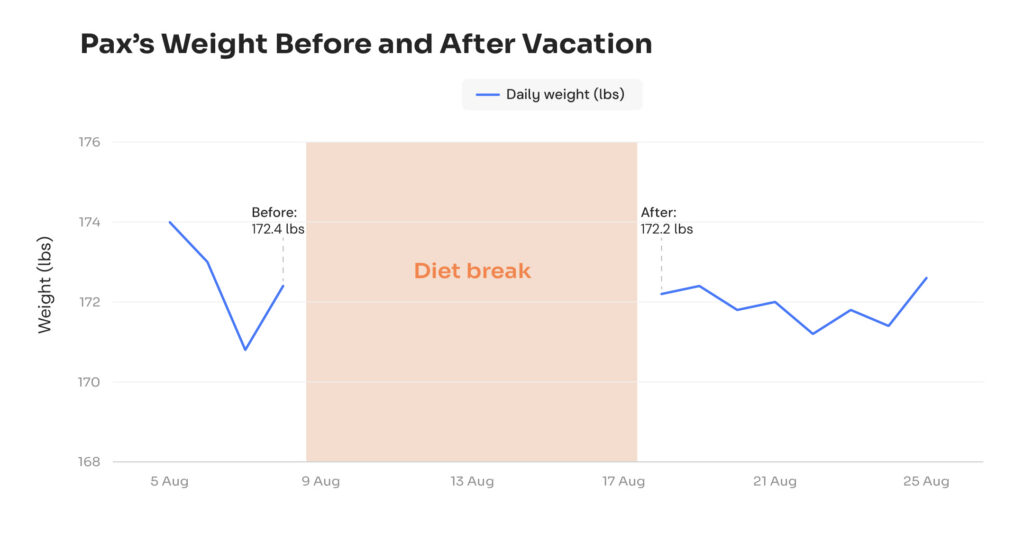
Pax’s first diet break coincided with a nine-day vacation. She opted not to track, but we set some “rules” to ensure she implemented healthy habits and kept the goal in mind. She started the vacation weighing 172.4 lb and returned at 172.2 lb.
We also planned week-long breaks around Thanksgiving and Christmas, giving her more room for holiday meals.
Fast-forward to February 2025, and Pax was going through a stressful breakup. Work stress also ramped up, and she noted lower energy levels and more hunger. I decided this would be a good time to take another break. By then, Pax had already lost close to 30 lb, and I knew forcing a deficit could backfire.
So, I increased her calorie target to around 2000 calories (Pax’s estimated maintenance at the time). We originally planned a two-week break, but we extended it to three weeks because she was still feeling the effects of the higher stress.
The graph below shows her calorie intake (A) and weight (B) during this time. As you can see, despite eating a bit more over those three weeks, she maintained her weight.
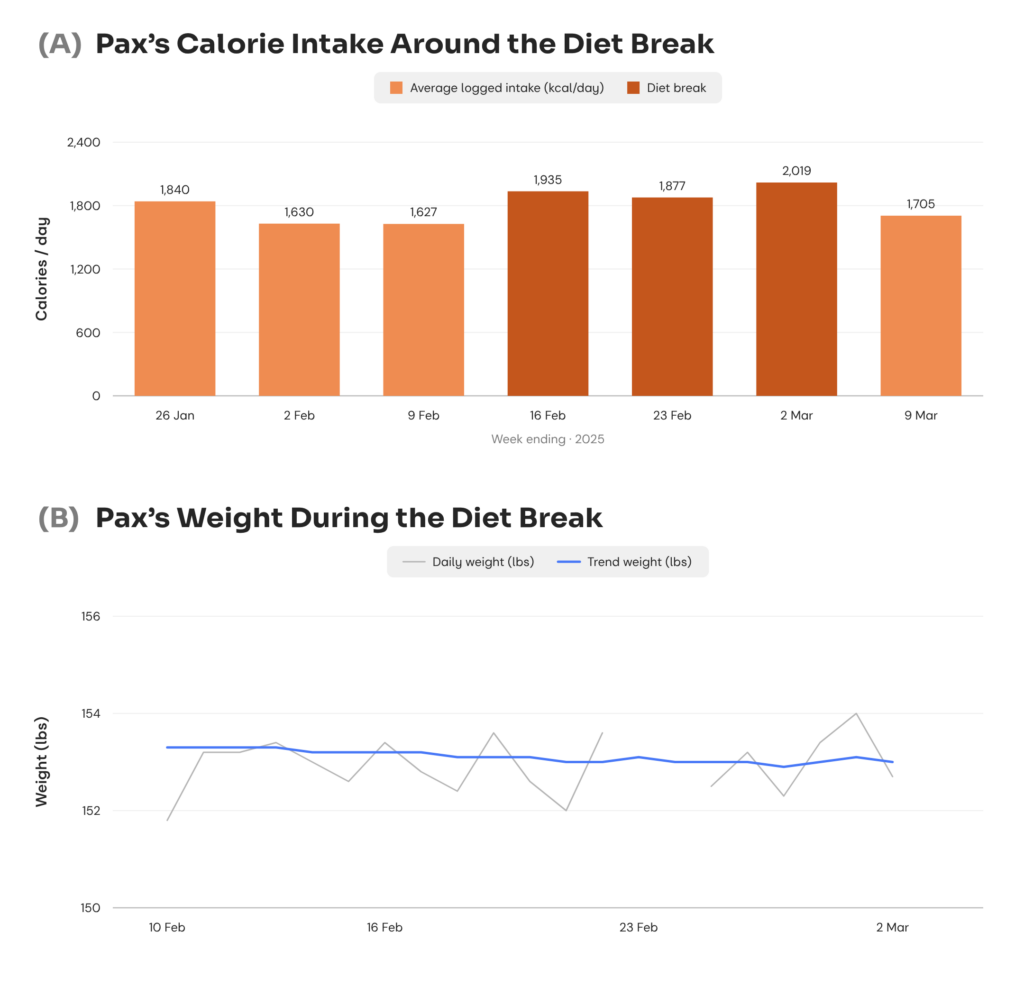
I share this because people often worry that taking time away from the deficit will ruin all their progress. In reality, what actually ruins progress is letting go of the healthy habits you were implementing during the deficit.
Forty pounds down and more comfortable in her own body
By July 2025, Pax’s weekly average weight was around 142 lb, roughly 40 lb below her starting weight. She had lost 5.5” from her waist and 6.5” from her hips.
She described what those changes meant to her:
I went from a size 12 to a 4! I love my body and am so proud of not only the fat loss but the muscle I maintained and built along the way.
And in a later check-in, she shared a change that no amount of “data” or before/after photos could capture:
I used to hate having my picture taken and dreaded family events and now I feel so confident and happy to be a part of the pics.
We then transitioned to maintenance. Pax was happy with her body, but understandably nervous about increasing her food intake after spending so long in an energy deficit. That phase brought more questions and adjustments. Work, travel, and routine changes made consistency harder at times. Over the next several months, however, her trend weight stayed around 141–143 lb, within a couple of pounds of where she finished the diet.
What Pax took from coaching
I never want to take credit for a client’s success. Pax did all the work. My role as her coach was to take some decision-making off her plate, provide guidance and accountability, and make sure the choices kept Pax moving toward her goal in a healthy, safe way.
When I asked Pax what her biggest takeaway was from coaching, she said:
You can achieve your goals with consistent effort and dedication. Even when you mess up a little just keep going, they’re not as big of a deal and don’t need to derail your progress.
Interested in coaching?
If you already know ‘what to do’ but aren’t making the progress you know you should be, coaching might be a good fit. You can apply here.
Thanks for reading. If you enjoyed this, you’d love the Vitamin
95% of my new content is only sent to my email list. One email every Thursday, filled with actionable, evidence-based fitness advice to help you with your goals. If you enjoyed this, you’ll love my emails.
Subscribe for free below or Learn more about the Vitamin