A reader recently asked whether a “muscle-to-fat gain ratio” could be calculated to map out an entire cut-and-bulk trajectory. Here’s the question:
In a recent newsletter (I can’t find) you dropped a statistic that typically 25% of weight loss is due to muscle mass, but that can be reduced to 10% through training and protein intake. This makes it easy to calculate how much weight you need to lose to hit a target body-fat percentage. Similarly, if you have this information, it should allow anyone to calculate a trajectory—X weeks of cutting at 0.7% bodyweight, Y weeks of bulking at 0.25 pounds of muscle per week plus N amount of fat—to get to the body-fat percentage and muscle mass they’re targeting.
The logic makes sense. If you know how much fat and muscle you can expect to lose or gain, you can calculate a target body-fat percentage and goal weight, then estimate how long it should take to get there.
But there’s a small problem: It assumes we know how much muscle you can gain. However, when we look at the research, it quickly becomes clear just how much variability there is.
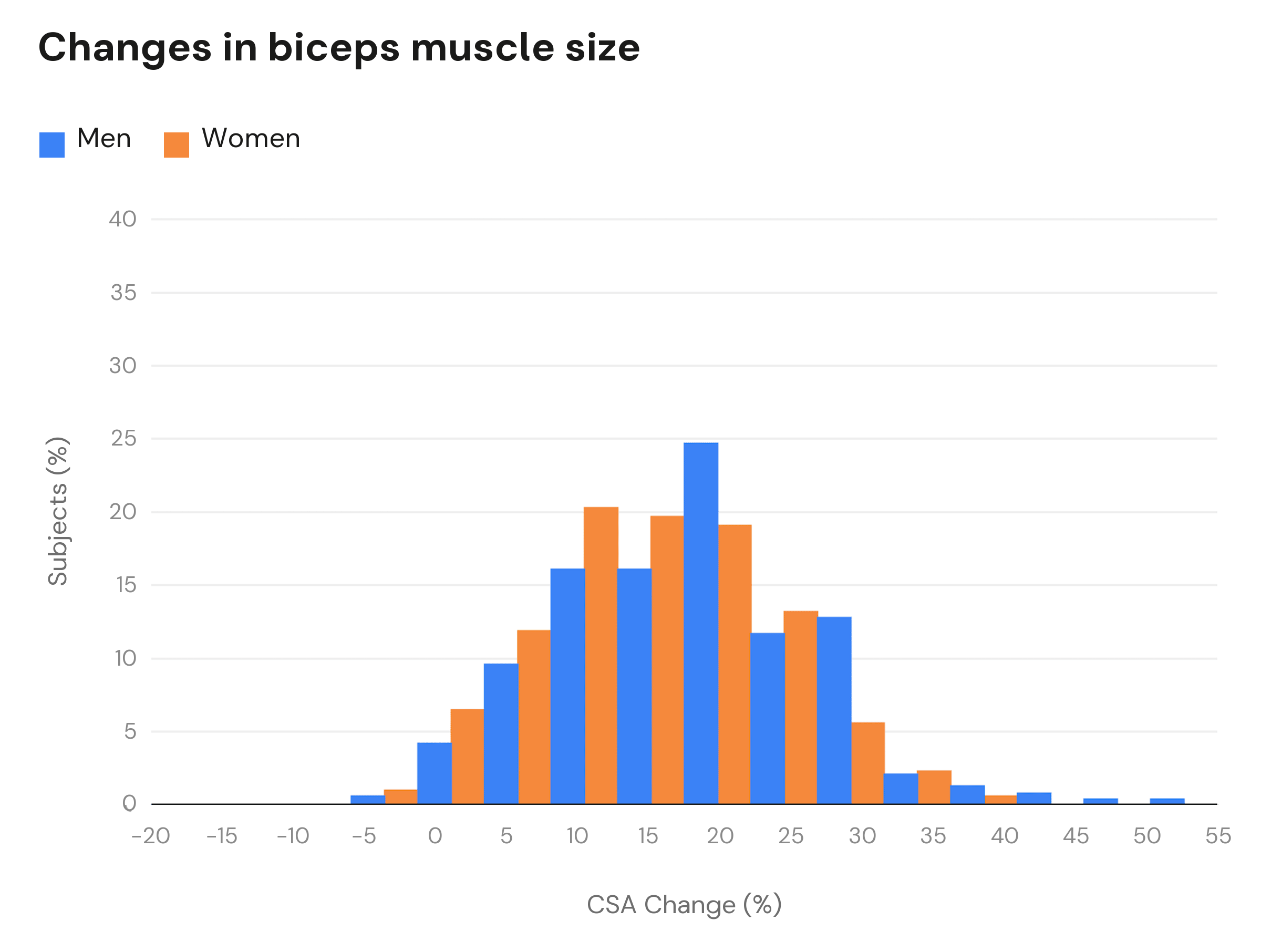
For example, in one paper, 585 participants (342 women) trained one arm for twelve weeks while the other arm served as the control. The biceps size changes ranged from -2 to +59%. That is, some individuals saw an increase of ~60%, while others saw no change.
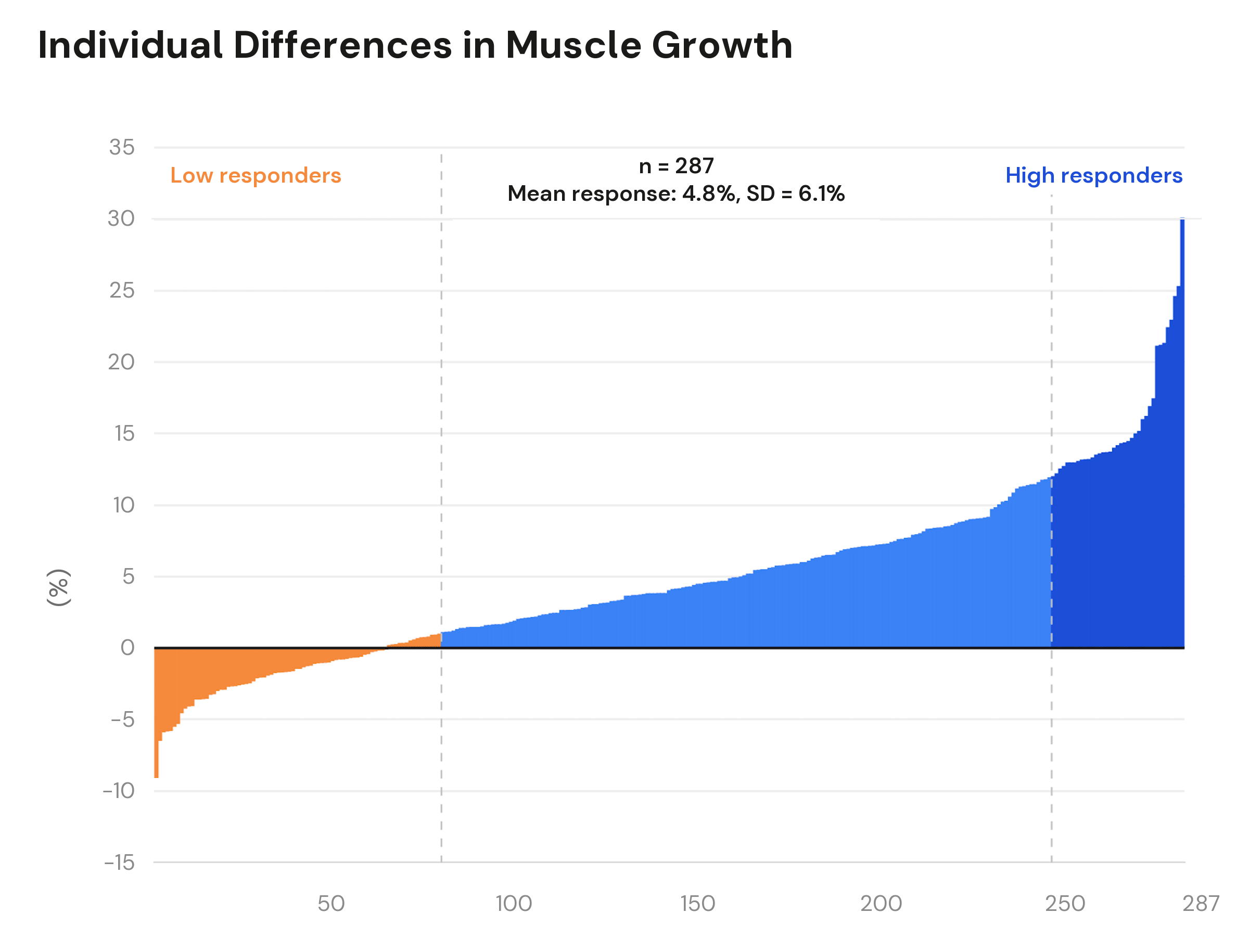
And this isn’t an isolated finding. In a separate study, researchers pooled 287 previously untrained men and women who completed 20-24 weeks of supervised resistance training. The average increase in muscle size was ~5%, but individual changes ranged from -11% to +30%.
A quick note: Please don’t interpret that as some poor bastards lost 11% of their muscle mass despite lifting. The non-training control group also showed large fluctuations in muscle size, so there was very likely measurement error and normal day-to-day noise contributing to some of these values. So the researchers used the control group as a benchmark of sorts. Specifically, participants had to see training-induced gains of more than 1.6% for that change to be considered ‘real’ (i.e. greater than the variation observed in people who weren’t training). Even after doing that, around 30% of participants were classed as low responders.
Why there isn’t a reliable muscle-to-fat gain ratio
And that’s the problem with trying to calculate exact ratios for a bulk. The fat gain side isn’t that hard to figure out. For instance, if someone eats 500 calories per day above their maintenance needs, we can estimate they would gain about a pound per week.
But we can’t work out how much of that would be used to build muscle because, as you’ve just seen, there’s a ton of individual variability.
Furthermore, we have quite a bit of research looking at the impact of a calorie deficit on body composition when combined with lifting and adequate protein intake.
For instance, when individuals with overweight and obesity lift weights while in a caloric deficit, almost all of the weight loss is body fat. In non-obese, resistance-trained individuals, higher protein intakes are associated with better retention of fat-free mass (and, in some cases, even muscle growth), and losses in fat-free mass tend to increase with the size of the deficit, highlighting the importance of avoiding crash dieting.
The same can’t be said for the muscle gain research. When Slater and colleagues reviewed the subject in 2019, they noted that there were no rigorously controlled long-term studies directly testing different levels of surplus during resistance training.
That being said, the few studies we do have all seem to point to the same thing: larger caloric surpluses, and by extension faster rates of weight gain, tend to lead to more fat gain without any real advantage in muscle gain.
How much of a surplus do you actually need?
Not nearly as much as people might think.
Back in 2008, Kevin Hall estimated that a kilogram of muscle contains roughly 1800 calories of stored energy, while a kilogram of body fat contains more than 9000 calories.
Now, of course, stored energy and actually building muscle aren’t the same thing. One way to think about this is like buying new furniture. There’s a cost for the furniture itself, plus additional costs attached for delivery and assembly. Well, unless you’re one of those psychopaths who enjoy building IKEA furniture. Similarly, the cost of muscle is just one small part of it, and there are further costs associated with building that muscle.
To illustrate this, a recent study (preprint) attempted to answer how many calories it actually takes to build a kilogram of muscle. Stored muscle tissue contained around 1350 calories per kilogram. When they accounted for the ‘cost’ associated with putting that tissue together, this number increased to ~2600 calories per kilogram of muscle. Lastly, they accounted for the energy used to maintain that muscle once it’s been built, and the calories lost digesting the additional food that’s consumed during this process.
Once all of this was added up, they arrived at an estimate of ~3500 calories to build a kilogram of muscle, or ~1600 calories per pound.
From there, they assumed that 1 kg of muscle was gained gradually over 12 weeks. Spread over that period, the estimated energy cost works out to only 41 extra calories per day.
Now, this doesn’t mean you need to literally eat exactly 41 calories to optimise your bulk. It’s just an estimate, and additionally, their model was based on data from infants and growing animals, not resistance-trained adults. The researchers themselves explicitly warn against interpreting that 41 calories per day as a recommended calorie surplus.
Nonetheless, what this paper— along with the other research we have —does tell us is that you probably don’t need to be deep-throating hundreds of extra calories every day to build muscle. A small surplus is likely the better option, especially since your strength training is what actually drives muscle growth. Your nutrition is there to support it.
In practice, it’s better to start a bit more conservatively, about 5-10% above your maintenance needs, and then gradually increase your intake if you’re not gaining at the rate you want.
For coaching clients, I’ll generally set the target rate of gain somewhere around 0.2-0.5% bw/week. Here’s what that could look like across a range of body weights:
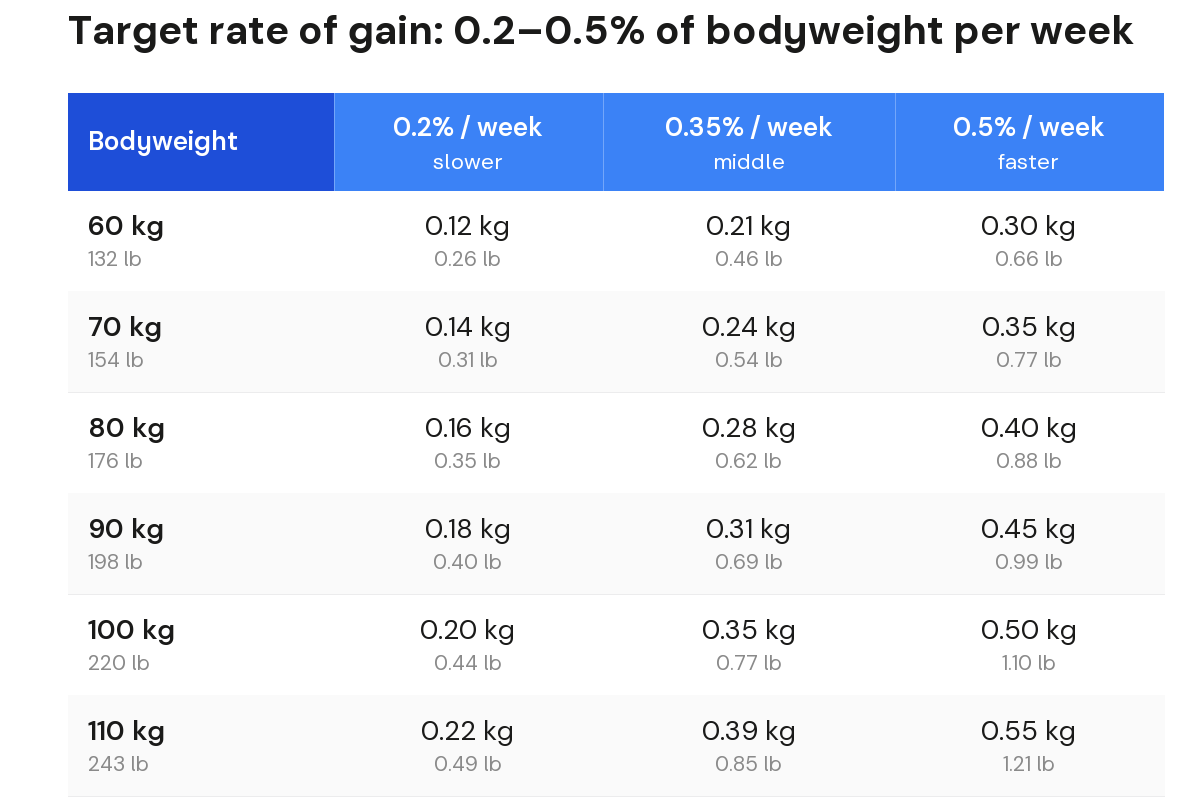
Beginner and intermediate lifters could get away with gaining toward the middle or upper end of that range because they have more potential for muscle growth, while advanced lifters will probably do better aiming toward the lower end.
TL;DR
- There isn’t a useful “X pounds of fat for every pound of muscle” rule. Muscle growth varies far too much among individuals to yield a ratio of any material use.
- You don’t need a huge surplus to build muscle. It’s better to start conservatively and adjust from there.
- Practically, set your initial calories 5-10% above your maintenance needs, and aim for a weekly rate of gain somewhere between 0.2-0.5% bw/week. Beginners and intermediate lifters can gain toward the middle or upper end of that range because they have more potential for muscle growth, while advanced lifters will probably do better aiming toward the lower end. If you’re not sure whether you’re a beginner, intermediate, or advanced lifter, err on the side of the lower end.
- Then track your weight, measurements, progress photos, and gym performance. If you’re gaining weight slowly, your measurements are moving in the right direction, your lifts are improving, and you’re not rapidly getting fatter, you’re likely gaining more muscle than fat.
Lastly, if your goal is to gain muscle, I recommend erring on the side of a slower rate of gain. Building muscle naturally takes an annoyingly long time, so you want to give yourself as much runway as possible. If you gain weight — and fat — too quickly, you’ll need to cut sooner, leaving less time to gain and less opportunity to build muscle.
But, as always, I’m not your dad. So you can do whatever the fuck you want.
Thanks for reading. If you enjoyed this, you’d love the Vitamin
95% of my new content is only sent to my email list. One email every Thursday, filled with actionable, evidence-based fitness advice to help you with your goals. If you enjoyed this, you’ll love my emails.
Subscribe for free below or Learn more about the Vitamin