TL;DR: No. One day of overeating won’t ruin your progress. Fat gain requires a sustained caloric surplus over time, not a single meal or day. Your body doesn’t operate on a 24-hour cycle. What matters is your average intake over weeks. Let’s dive into the math of fat gain, and I’ll show you why you don’t need to worry about one day of eating a bit more than usual.
It’s easy to feel like you’ve ruined your progress when the scale fluctuates after a day of eating more than usual. But the truth is, it’s virtually impossible to gain substantial body fat from one day of overeating.
Let’s talk about that.
The factors that influence fat storage
We all burn a certain number of calories every day — what’s known as total daily energy expenditure. If you were to eat exactly the same amount you’re burning, your weight would stay the same. If you eat less than you burn, you lose weight; if you eat more, you’ll gain weight.
A pound of fat contains about 3,500 kcals (or 1kg of fat = 7700 kcals), so if you ate, hmm, I dunno, 1000 calories over your maintenance intake, you might store 0.3 lbs of fat.
I say “might” because there are a few factors that will affect how much of the excess intake can be deposited as the sludge that sticks to your waistline.
1-How much is actually absorbed?
Before we look at the calories that can be stored, we need to take a step back, because not all the calories you eat actually reach that point.
Controlled feeding studies using bomb calorimetry have shown that humans lose, on average, about 5% of ingested energy in faeces and ~0.5–2% in urine, although this varies widely between individuals. Across studies, total energy absorption ranges from roughly 80% to 95%. And yes, it’s exactly what you’re thinking: they burn people’s poop to determine the number of calories the body didn’t absorb.

2- Thermic effect of food
Of the calories that survive, some more are lost to the energy expended in digesting and storing the food you eat. This is called the thermic effect of food (TEF), and while carbs, fats, and proteins each ‘cost’ a different amount of energy to process, TEF averages around 10% of total calories consumed.
3-Changes in NEAT
There will also be an increase in energy expenditure, notably through an increase in non-exercise activity thermogenesis (NEAT)–i.e., all the calories you burn from daily activity, excluding exercise.
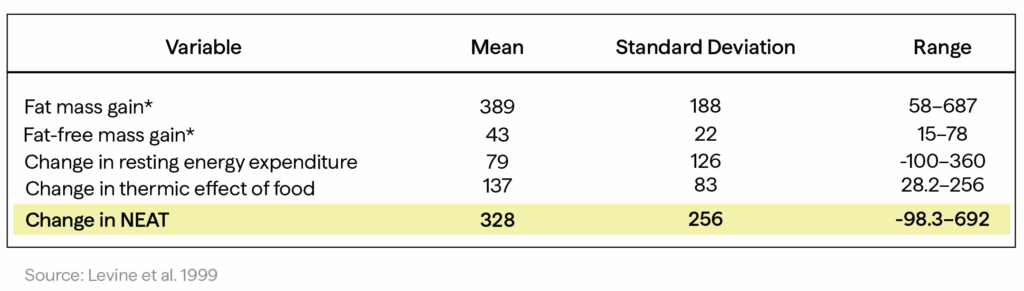
Generally, people tend to move more when overfed. But this isn’t always the case. For instance, Levine et al. found a mean increase in NEAT of 328kcal/day after overfeeding participants by 1000kcal/day. However, this ranged from -98.3 to 692 kcal.
4. The types of foods you eat
Finally, the type of foods you eat will also influence how much fat you store. The body rarely converts carbs and protein directly into fat, whereas it directly stores dietary fat.
In one study, participants were overfed 50% of their maintenance intake, either entirely from carbs or entirely from fat. After 24 hours, the body stored only 10% of the excess calories in the carb group as fat. However, the dietary fat group stored about 60% of the excess calories.

Before moving on, I want to clarify that this doesn’t mean you can eat unlimited carbs and protein and avoid fat gain.
When you overeat carbs, your body prioritises burning those carbs for energy. But while it’s doing that, it’s not burning fat—so your body stores any dietary fat you eat. Furthermore, while it’s very unlikely to happen outside of extreme carb overfeeding, the body can convert carbs to fat through a process called de novo lipogenesis (DNL).
In a classic study by Acheson and colleagues, participants consumed ~5,000 kcal/day, with 88% of those calories from carbs. On day one, the body stored most of the surplus as muscle glycogen and converted only 110g to fat. By day four, once glycogen stores had maxed out, the body had no choice but to convert the excess carbs into fat, producing about 160g of new fat per day.
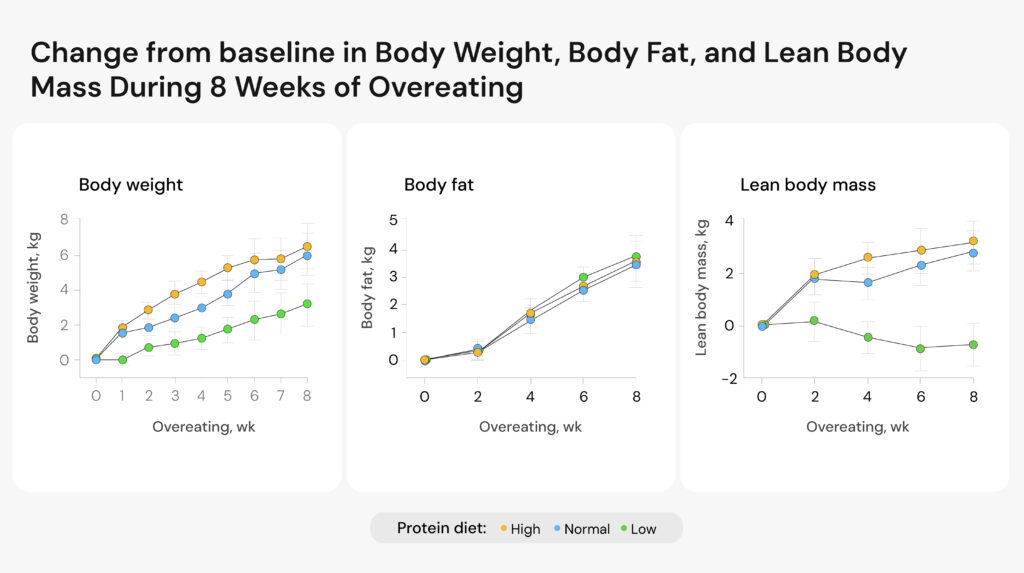
It’s a similar story for protein. In an 8-week overfeeding study in which participants ate roughly 950 extra calories every day, all protein groups—low (6%), normal (15%), and high (26%)—gained about 3.5 kg of fat. The only difference was that the higher protein groups gained more lean mass.
But there’s another factor that affects how many of those extra calories your body can actually use: food processing. Generally speaking, the more processed a food is, the more of those calories the body can use and absorb.
For example, whole almonds still have much of their fat trapped in cell walls, so you absorb only about 70% of what the label claims. Roast, chop, or turn them into almond butter, and more of the calories are available for the body to absorb.

So, let’s say you overeat by 1,000 calories in a day. How much fat would you actually store? Let’s take everything we’ve just discussed and see.
How much fat would you gain from one day of overeating 1000 calories?
Step 1: Account for energy absorption efficiency
Studies show humans absorb between 80–95% of the calories they eat. Let’s pick a midpoint of 90% absorption efficiency, meaning you lose 10% of calories via faeces/urine.
So: 1,000 kcal × 0.9 = 900 kcal actually absorbed
Step 2: TEF adjustments
I’m going to keep TEF at 10% since this seems to be the amount you can expect in short-term overfeeding.
- 900*0.9 = 810 calories
Step 3: deduct the increase in NEAT
As mentioned earlier, some people don’t see an increase in NEAT, while others do. So, let’s go somewhere between the range provided in the Levine study and say you burn 300 calories via NEAT.
- 810 – 300 = 510 calories
Finally, if you overeat by 1000 calories, chances are it’s from high-calorie, high-fat, heavily processed foods. So, let’s assume 50% of the calories came from high-fat, heavily processed foods.
- 510*0.5 = 255 calories left for storage.
After all of that, we have about 250 kcals left over for storage, which equals 0.07 lb of fat gain (250/3500 = 0.07).
Let’s gut-check this number
If you’re wondering how my back-of-the-napkin math compares to real-world overfeeding studies – pretty damn close.
In a systematic review, Bray and Bourchard plotted weight gain against surplus calories across 13 different overfeeding studies. They found that for every 1,000 extra calories eaten, participants gained roughly 0.094 kg (~0.2 lbs) in total body weight. When they specifically looked at fat gain, the figure was about 0.06 kg (~0.13 lbs) per 1,000 calories.
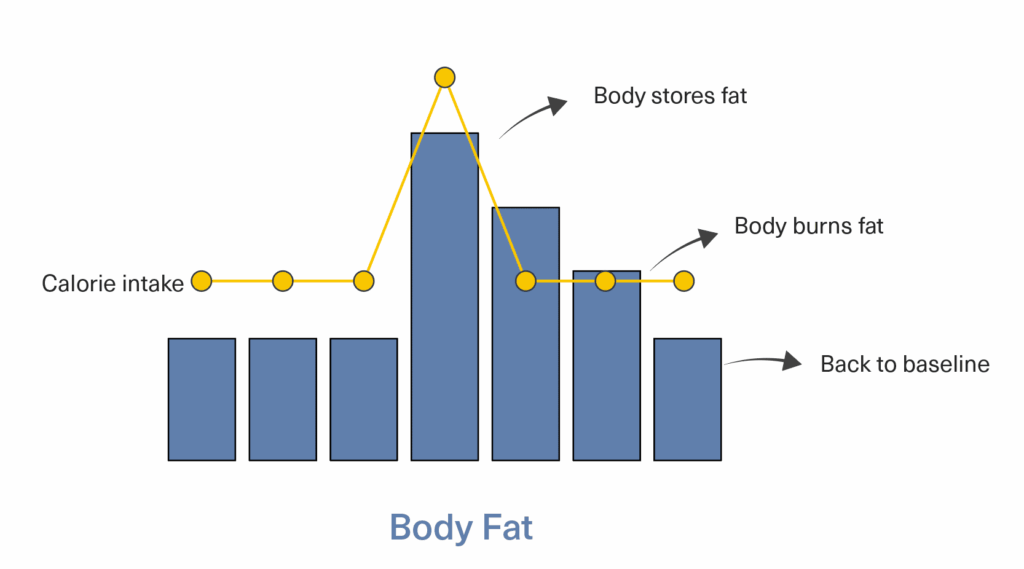
As you can see, while you will gain some fat, it’s actually pretty minuscule. And if you get back on track the day after, it’s nowhere near enough to ruin your progress. This is due to ‘fat balance‘—the balance between fat stored and fat burned.
One day of overeating will lead to a little bit of fat gain. But once you get back to eating normally, your body will burn off the excess fat, and you’ll be right back to where you were before the high-calorie day.
So why do you weigh so much more after one day of overeating?
People mistake weight gain on the scale for fat gain. But the increase you see on the scale after a day of heavy eating is actually due to a combination of increases in glycogen, water, sodium, and carrying more food in your stomach.
To further illustrate this, if your weight fluctuated by 5 lbs after a high-calorie day, you would have needed to consume 17,500 kcals to account for 5 lbs of body fat—an impossible amount to eat in one day for anyone.
Taking all of this together, you can see that one day of eating more than usual is unlikely to derail your progress. What does derail progress is falling into the trap of thinking you’ve ruined everything and then proceeding to eat like a fuckface for the rest of the week.
Instead of worrying about that one day, focus on the entire week and getting back on track because the faster you do that, the less impact one day of overeating will have on your long-term progress.
Thanks for reading. If you enjoyed this, you’d love the Vitamin
95% of my new content is only sent to my email list. One email every Thursday, filled with actionable, evidence-based fitness advice to help you with your goals. If you enjoyed this, you’ll love my emails.
Subscribe for free below or Learn more about the Vitamin