Q: I’ve been considering how weight loss affects your appetite. Once I’ve reached my goal weight, will my appetite automatically adjust to match my maintenance calorie intake? Or is maintenance more of a matter of getting accustomed to eating less?
The short answer:
Appetite doesn’t automatically “reset” once you hit your goal weight. Instead, it undergoes a gradual recalibration, driven by both biological changes (such as shifts in hunger hormones) and behavioural factors (like habits, activity, and food choices). So while you won’t magically feel “normal” at maintenance right away, things do level off, especially if you take maintenance just as seriously as you did the diet.
The deep dive
The impact of weight loss on hormones
Weight loss tends to trigger a change in appetite hormones, such that satiety hormones decrease while hunger hormones increase.
For example, a comprehensive meta-analysis of 127 studies confirmed that weight loss reliably increases total ghrelin levels (the primary hunger hormone), while tending to decrease PYY and active GLP-1, among other satiety signals.
Interestingly, though, this shift in the balance of hunger and satiety hormones doesn’t necessarily mean weight regain is inevitable. A 2017 review notes that:
…little evidence within the reviewed studies support pre- or post-weight loss leptin, ghrelin or insulin sensitivity as predictors of regain. These findings suggest that, despite the important roles that leptin, ghrelin and insulin seem to exert in energy homeostasis, their changes during weight loss, taken alone, are not sufficient predictors of weight regain in free-living humans. (Emphasis mine.)
In other words, while hunger hormones like leptin and ghrelin do change during weight loss, causing an uptick in hunger, these changes alone aren’t reliable predictors of weight regain in the real world, where dozens of other factors can play a role.
Moreover, there appears to be some adaptation in appetite that occurs when people maintain their weight loss.
Nymo and colleagues noted that participants who maintained a 15% weight loss for a year experienced an increased drive to eat in the fasted state; however, this was balanced out by increased fullness after eating. The researchers also speculated these changes might not be the body trying to sabotage weight loss, as is often assumed, but rather a normalisation of appetite hormones. That is, the post-weight-loss shift in hunger and satiety signals could just be the body recalibrating to operate more like a lean individual’s—higher fasting ghrelin, but also better satiety responses after eating.
How does appetite adapt during weight maintenance?
Your appetite won’t suddenly normalise when you return to maintenance.
However, it will begin to level off somewhat as you transition to maintenance and increase your calorie intake. Of course, there will always be individual differences. And these differences can be explained by the dual-intervention model.
We all have a range within which our bodies regulate weight–an upper and lower limit.
If you hit the lower limit (getting too lean), your body resists further loss by increasing hunger and reducing energy expenditure. If you reach the upper limit (gaining too much weight or fat), your body responds by pushing back to prevent further gain, reducing appetite and increasing energy.
Where you sit on this range depends on your habits and environment until you reach the lower or higher intervention points, at which point physiology takes over. It’s important to note that, in today’s environment of highly palatable and easily accessible food, the upper intervention point is often less strongly defended, making it easier to gain weight.
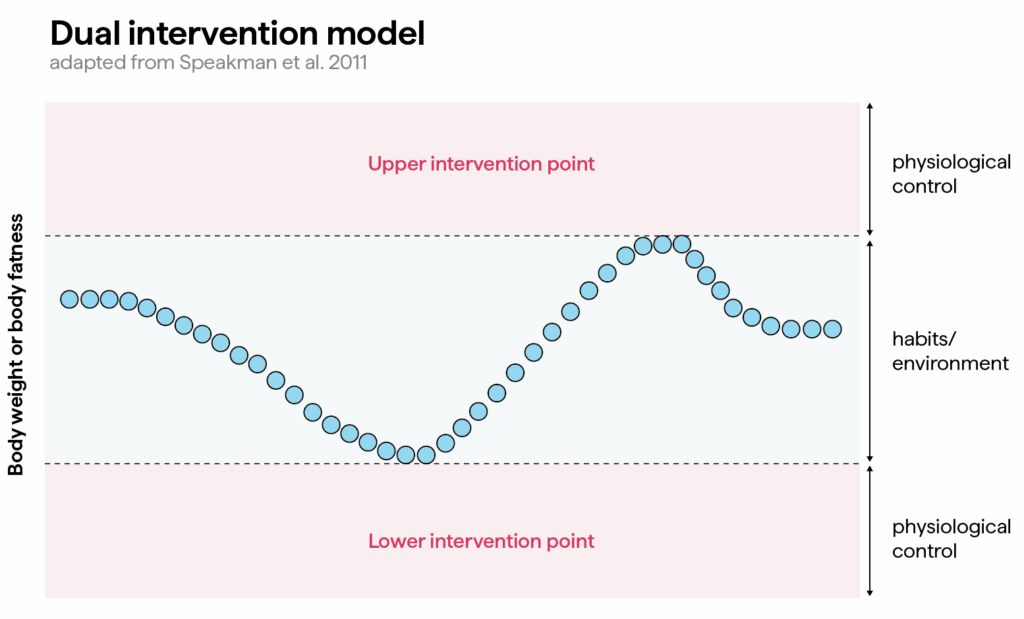
To make the above a bit more concrete, I’ll use myself as an example.
- My lower intervention point is around 9-10% body fat. I can definitely get leaner than this, but my hunger skyrockets and my energy nosedives off a cliff, and I want to sit or lie down all day.
- My upper intervention point seems to be around ~20% body fat. At that point, my hunger levels are nonexistent, and I won’t stop moving.
Between those two points, my habit and environment will dictate my hunger and how lean I can stay.
If, for example, I wanted to maintain around 12% body fat, I would need to be a bit more intentional with my food choices and likely increase my step count. On the other hand, if I wanted to maintain a body fat percentage of around 15%, I could be a bit more relaxed with my food selection and not overly concerned about reaching a relatively high step count.
This dovetails nicely into the importance of establishing healthy habits because, yes, physiology plays a role, but your environment and habits play an equally important role. To highlight a few:
Regular physical activity
Weight loss invariably reduces the number of calories needed to maintain your new body weight, which can increase hunger.
Increasing physical activity—both formal (such as weight training and cardio) and informal (like walking or general movement)—allows you to eat more while maintaining energy balance. This can help reduce hunger and increase your chances of keeping the weight off.
Physical activity also appears to affect appetite regulation. For example, in sedentary individuals, appetite is often dysregulated, leading to overeating. Adding exercise brings them back into the ‘regulated zone’, where their intake better matches their energy needs.
Additionally, evidence suggests losing more muscle during a diet can increase the chances of weight regain through increased appetite. For instance, the meta-analysis I mentioned earlier found individuals who lost more muscle had a greater spike in ghrelin (the primary hunger hormone) and a more significant drop in GLP-1 (which promotes feelings of fullness).
Improved diet quality
Your ‘maintenance diet’ should look similar to your fat loss diet, just with a bit more food––the same eating habits that helped you lose fat will help you maintain fat loss.
For example, protein has several benefits, including, but not limited to, improved weight and fat loss, preservation of muscle mass, and increased satiety. Higher protein intake can also help with weight maintenance. Similarly, fiber intake can increase feelings of fullness since it adds ‘bulk’ to the diet and slows digestion. In fact, some research suggests fiber can promote weight loss independent of caloric intake.
On the other hand, foods that are ‘ultra-processed’ and calorically dense cause people to eat more because heavily processed foods are easier to eat, contain more calories, and aren’t as filling.
Regular self-monitoring
In a 2023 paper, Phelan and colleagues found that a decline in self-monitoring was one of the strongest predictors of weight regain.
This shouldn’t be that surprising. If you’re keeping an eye on your weight, you can adjust your habits if you find it’s slowly creeping up. By being mindful of your caloric intake, you can catch ‘calorie creep’ sooner, ensuring you’re not consistently consuming more calories than you should. Tracking things like your step count can help you identify times of the year when you’re more sedentary and how that correlates with weight gain, allowing you to adjust your activity as needed. It’s not really the tracking itself that’s beneficial; it’s the awareness that tracking brings, allowing you to adjust your behaviours accordingly.
The bottom line
Your appetite will gradually adjust after weight loss, but it won’t perfectly align with your new calorie needs immediately. How quickly your appetite stabilises will depend on the habits you’ve built and how lean you got at the end of the diet. Even the best habits won’t prevent your body from freaking out if you go below your lower intervention point. In this case, hunger will remain high until you gain some body fat. On the other hand, you can stay relatively close to your lower intervention point with a concerted effort on the healthy habits discussed above – regular physical activity, eating enough protein and fiber, and monitoring your weight and caloric intake.
Thanks for reading. If you enjoyed this, you’d love the Vitamin
95% of my new content is only sent to my email list. One email every Thursday, filled with actionable, evidence-based fitness advice to help you with your goals. If you enjoyed this, you’ll love my emails.
Subscribe for free below or Learn more about the Vitamin