In a previous article, I explained why the idea that you should never dip below a certain calorie intake is…well, kinda dumb without context.
Initially, the piece included a section debunking another popular claim: that eating below your resting metabolic rate is inherently dangerous. But I ended up cutting it because I have a terrible habit of cramming too much into a single post. The good news, though, is that the section didn’t go to waste because I’m sharing it with you in today’s Vitamin.
Quick note before we begin: I’ll be using RMR (resting metabolic rate) throughout this piece, even though BMR (basal metabolic rate) is slightly different (it’s about 10% lower) and measured under stricter lab conditions. But they’re both referring to the same thing, and I’ve always used RMR, so I’m sticking with it.
The biggest concern I hear when people talk about eating below their RMR is that it’ll somehow break their metabolism. Permanently. But that’s not how it works.
In fact, we’ve got plenty of research showing that people can dip well below their basal energy needs for extended periods without any lasting damage. I won’t run through every study, but to highlight a few.
Way back in 1990, Wadden et al. conducted a 48-week randomised controlled trial in obese women following a continuous low-calorie diet (~1200 kcal/day) or an initial very-low-calorie diet (~420 kcal/day for 16 weeks) followed by a low-calorie diet (~1200 kcal/day).
On average, the women on the low-calorie diet had an RMR of 1870 kcal, while those in the very-low-calorie group averaged 1830 kcal.
The very-low-calorie group experienced a rapid initial drop in RMR (a ~20% reduction in the first month) outpacing the amount of weight loss (~7%), by week 48, the drop in RMR had stabilised, now sitting just 8% below baseline, while total weight loss hit ~20%.
Even the group who stayed on the ‘higher-calorie’ diet (~1200 kcal/day) showed a disproportionate early drop in RMR — 9% in the first five weeks — despite losing far less weight (just a few per cent). By week 48, they’d lost ~16% of their body weight, with RMR still sitting about 9% below baseline.
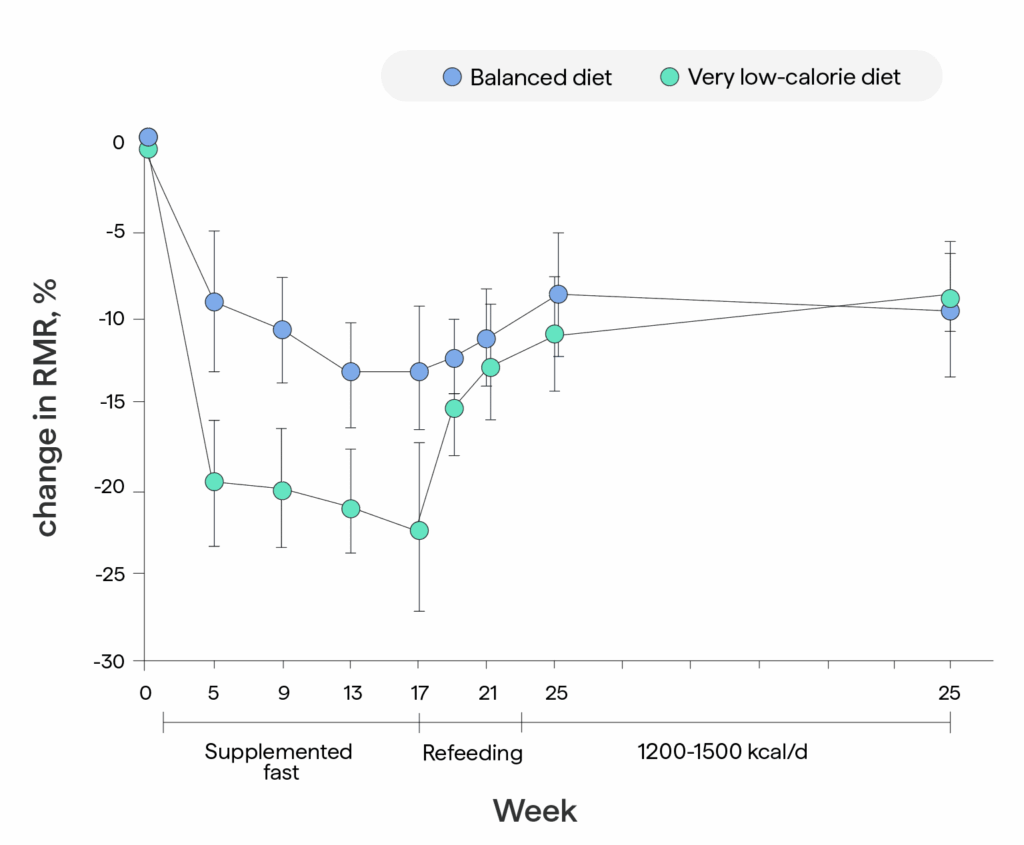
In other words, severe caloric restriction didn’t result in a permanent “metabolic damage” beyond what a lower body mass predicts. Both groups lost substantial weight, and neither had an abnormally low RMR at 1 year relative to their new body size.
More recently, Hintze and colleagues investigated the changes in RMR in 36 women assigned to either a 500-calorie deficit for 20 weeks or a 1000-calorie deficit for 10 weeks. Both groups ate below their measured RMR and lost weight, and there were no differences in their metabolic rate by the end of the study.
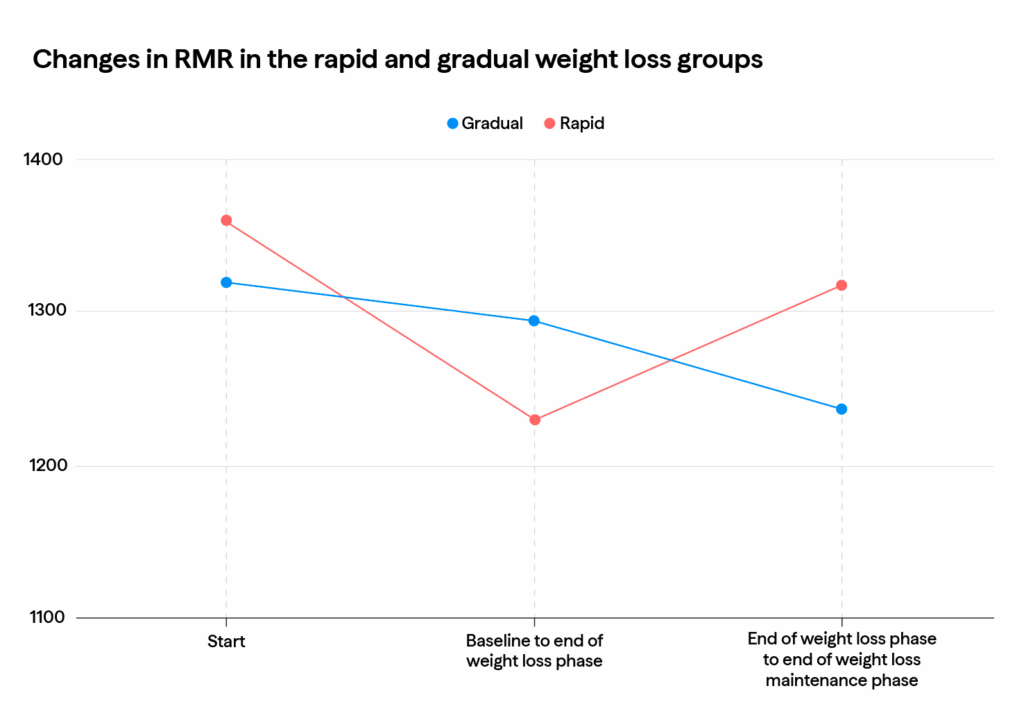
Similarly, Coutinho and colleagues compared rapid vs. gradual weight loss. The rapid group ate 660/550 kcal (men/women), while the gradual group ate 1500/1200 kcal (men/women). RMR dropped by ~130 kcal in the rapid group vs. just 24 kcal in the gradual group. However, both groups showed a rebound in RMR during maintenance.
Finally, Bryner et al. placed 20 overweight individuals (17 women and three men) on an 800-calorie/day liquid diet combined with either resistance training or cardio for 12 weeks. Both groups lost weight and body fat, but the resistance training group saw an increase in their RMR.
So, what’s going on here?
Your body doesn’t just run on the food you eat. It also taps into stored body fat, which is the entire point of a calorie deficit. You’re creating an energy gap, so your body is forced to dip into its stored energy.
And those stores are significant.
Let’s say you have 30 lbs of fat to lose, and assuming each pound of fat contains 3500 calories (or each kilogram contains 7700 calories), that’s over 100,000 calories of stored energy the body can tap into.
With that much stored energy, you could technically go a very long time without eating. One of the most extreme examples is Angus Barbieri, who, under medical supervision, fasted for over a year and lost 270 lbs (about 120 kg).
No, he didn’t photosynthesise energy from the sun––his body was running almost entirely on its own fat stores. While this isn’t something you’d ever want to replicate, it’s a powerful example that having extra body fat isn’t just “dead weight” — it’s fuel your body can use to keep you alive and functioning when food intake is low.
But what if you’re not super overweight?
That’s when things start to shift. As body fat levels drop, your body becomes less generous with its energy. It realises it’s no longer sitting on a giant calorie trust fund, and your metabolic accountant slashes budgets.
Instead of continuing to pull mostly from fat, it may start breaking down muscle to meet energy needs. Hormones like leptin, thyroid, and testosterone begin to dip. NEAT (all the calories you burn just moving around) plummets. You get tired, cold, cranky, and generally less fun to be around, which basically sounds like me whenever someone invites me to their dumb party.
But here’s the key: This isn’t happening because you’re eating below your RMR but because your body fat is getting low, and you’re not eating enough to meet daily energy demands. In fact, you could be eating above your RMR and still run into these issues if your body fat is low enough.
Here are two examples to really drive this home.
In the first study, male and female physique athletes were tracked during competition prep. The men reached 5% body fat and the women 12%. Their RMRs dropped to ~1600 and ~1300 kcal, respectively, while eating ~1900 and ~1700 kcal per day. And still, both groups experienced hormonal changes, increased hunger, and suppressed reproductive and immune function.
In a separate case study, a drug-free male bodybuilder dieted for 6 months to reach 4.5% body fat. Despite eating above his measured RMR, he still experienced significant fatigue, decreased testosterone, and other symptoms of low energy availability because he decided to become a walking anatomy chart.
So, to be clear: Eating below RMR isn’t inherently dangerous. But being too lean while eating too little for too long? That’s when it gets dicey.
Thanks for reading. If you enjoyed this, you’d love the Vitamin

95% of my new content is only sent to my email list. One email every Thursday, filled with actionable, evidence-based fitness advice to help you with your goals. If you enjoyed this, you’ll love my emails. You can learn more and subscribe for free here.