Creatine is one of the most studied supplements for muscle and strength. But could it also improve cognitive performance? Is it really a brain booster or just another overhyped claim? Here’s what the research shows.
Inside your body right now, trillions of tiny molecular batteries are being drained and recharged on a loop. These batteries are ATP (adenosine triphosphate). ATP is the universal energy currency of the body, and every single thing your cells do that requires energy uses ATP.
Those bicep curls you did earlier? ATP powered the muscle contraction. The lunch from an hour ago that’s being digested? ATP has a role in that. Your heart beating? ATP. Your neurons firing so you can read this sentence? Also ATP. Even the act of thinking about ATP requires, you guessed it, ATP.
But there’s a problem. Your cells only keep a small stockpile of ATP, and when there’s a need for energy, like say during a weight lifting session, one of the phosphate molecules breaks off from ATP–releasing energy that powers the muscles.
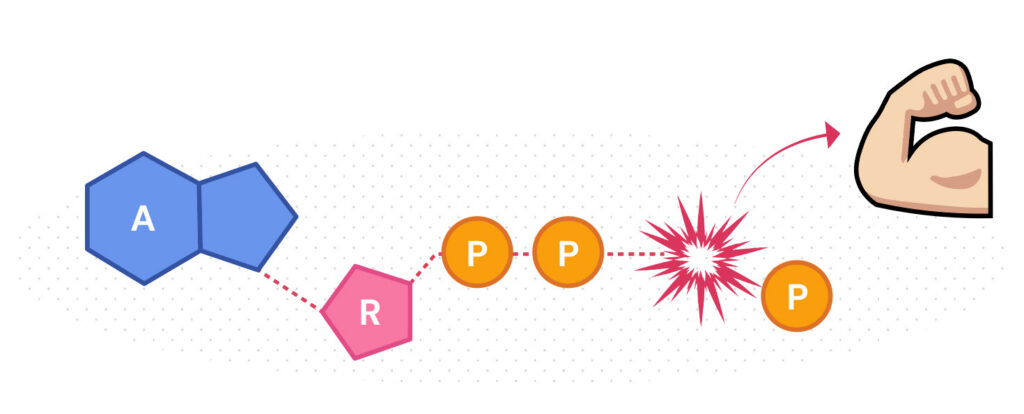
Once ATP ‘donates’ a phosphate molecule, it becomes adenosine diphosphate (ADP). You can think of ADP like your phone at 5% battery in desperate need of a charge.
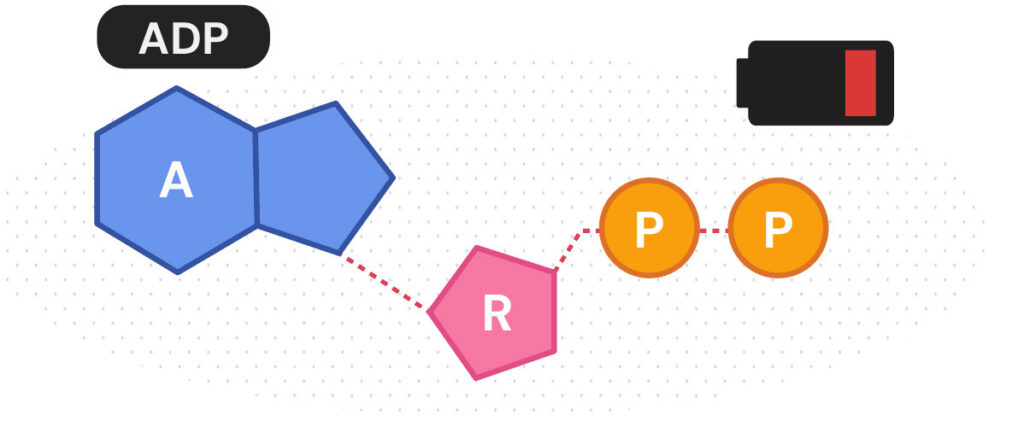
This is where creatine comes in.
Your body produces creatine mainly in the liver, and inside your cells, it gets converted into phosphocreatine — a high-energy compound that acts like a portable charger for your cellular batteries. When ATP runs low and demand spikes, phosphocreatine steps in, donating its phosphate to rapidly regenerate ATP.
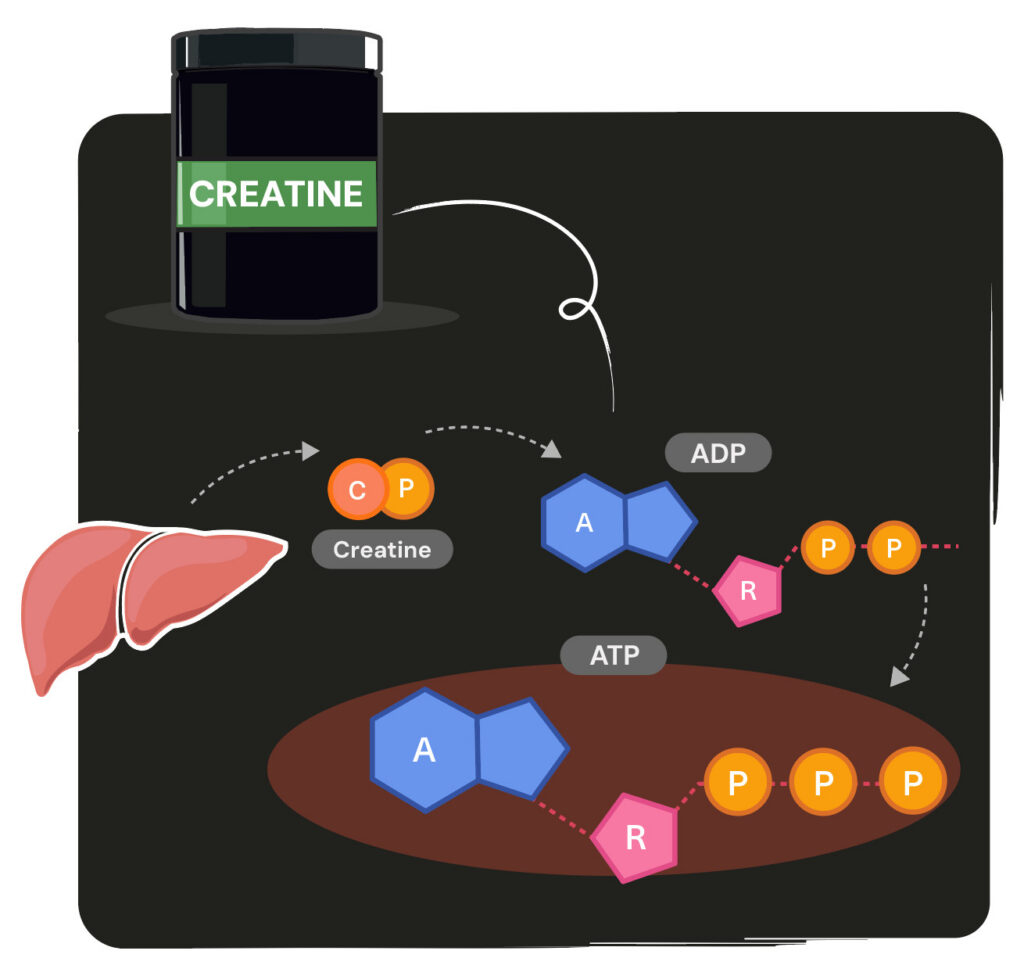
Creatine supplementation increases the amount of phosphocreatine available to cells, providing a larger energy buffer when demand is high. That’s why you can often eke out an extra rep or lift slightly heavier weight when supplementing with creatine.
At this point, you’re probably thinking, Cool, but what the fuck does this have to do with the brain?
Well, see, your brain’s an energy hog.
Despite accounting for only about 2% of your body weight, it consumes roughly 20% of your total energy, making it one of the most energetically demanding organs in the body. And unlike your muscles, your brain doesn’t take a break – it’s working 24/7 to keep you alive, and that requires a continuous supply of ATP.
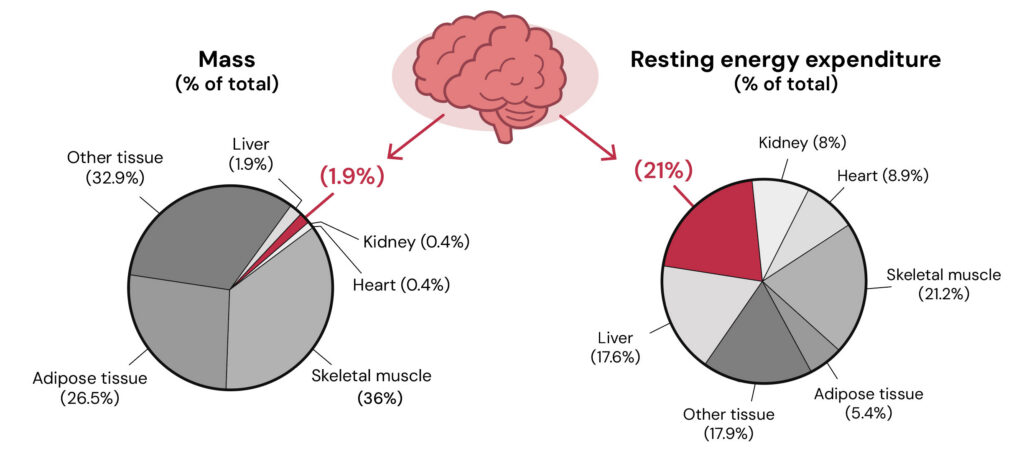
So, the question is, could creatine supplementation provide the same kind of energy boost to the brain that it provides to muscle?
Well, let’s see.
Creatine, cognition, and young, healthy adults
Let’s start with the disappointing news: if you’re a healthy young adult who eats meat and sleeps reasonably well, creatine isn’t going to turn you into Bradley Cooper from Limitless.
That might come as a surprise if you spend a lot of time immersed in social-media “fitness,” where influencers confidently claim the opposite. But the research behind those claims has serious problems.
Take the most recent review by Xu and colleagues, published in July 2024. They reported that creatine produced small improvements in memory and cognitive speed, based on a large body of evidence and participant data. Pretty cool, right?
But let’s dig a bit deeper.
Initially, the researchers state they analysed 16 studies involving 492 participants in total. That’s the entire dataset. But when you get to their memory analysis, they suddenly claim to have analysed data from 24 studies and 1025 participants.
Wait, what? How did 16 studies become 24, and 492 participants become 1,025?
No, the participants didn’t learn the shadow clone jutsu–it’s because the researchers made the mistake of double-counting.
Many studies gave participants multiple memory tests—forward recall, backward recall, spatial memory, etc. Instead of combining these into a single result per study, Xu and colleagues treated each test as a separate entry, as if it came from a different person. One study with 28 participants and 7 memory tests became 7 separate entries in the analysis. Treating multiple tests from the same participants as independent data points is a problem because it inflates the apparent evidence and exaggerates small effects.
Notably, the same problem occurred in an earlier review by Prokopidis and colleagues. Their original meta-analysis reported a small overall memory benefit of creatine, driven entirely by older adults, with no effect in younger participants. After the double-counting issue was raised, they reanalysed the data, and the overall effect was no longer statistically significant, although an effect remained for older adults (ages 66–76). We’ll come back to this group later.
Even when you look past these issues, the evidence for cognitive benefits in healthy young adults is inconsistent. A 2024 review by McMorris and colleagues examined 15 studies (500 participants) and found results were “equivocal” both between and within studies—that is, even within the same study, some cognitive tests showed improvements while others didn’t.
And in a randomised controlled trial by Moriarty and colleagues, there were no cognitive improvements in 30 young men and women who received either a moderate (10g/day) or high (20g/day) dose of creatine over six weeks.
Taken together, the current evidence doesn’t suggest that creatine reliably improves cognitive performance in young, healthy adults.
All of this raises an obvious question: If creatine supplementation can so dramatically increase phosphocreatine availability in muscle, why doesn’t the same thing happen in the brain?
See, creatine needs a specialised transporter to cross the blood-brain barrier, and that transporter appears to work near saturation under normal conditions. What this means in practice is that even when you’re supplementing with high doses of creatine, and blood creatine levels are elevated, your brain’s only letting in a small fraction of what’s available. For comparison, muscle creatine increases by about 20% with just 5g/day, whereas 20g/day only seems to increase brain creatine by 10%.
What about vegetarians?
If creatine improves cognitive function by supporting brain energy metabolism, then vegetarians, who have lower creatine stores, should see the biggest cognitive boost from supplementation. And early research did seem to support this.
In a 2003 study, Rae and colleagues reported that cognitive performance improved after 45 healthy vegans and vegetarians supplemented with 5g/day of creatine for six weeks.
However, larger and more recent evidence suggests that this effect is much smaller than originally reported and not specific to vegetarian diets.
In the largest replication to date, creatine produced at most a small improvement in working memory, had no meaningful effect on reasoning, and didn’t benefit vegetarians more than omnivores.
In support of this, Solis and colleagues found that vegetarians and meat-eaters have similar total brain creatine content, despite clear differences in dietary intake.
This makes more sense when you consider how the brain handles creatine. In a study measuring phosphocreatine responses to supplementation, Solis and colleagues found that while muscle creatine increased significantly across all age groups (vegetarians showing the largest increase at +28%), brain creatine barely budged.
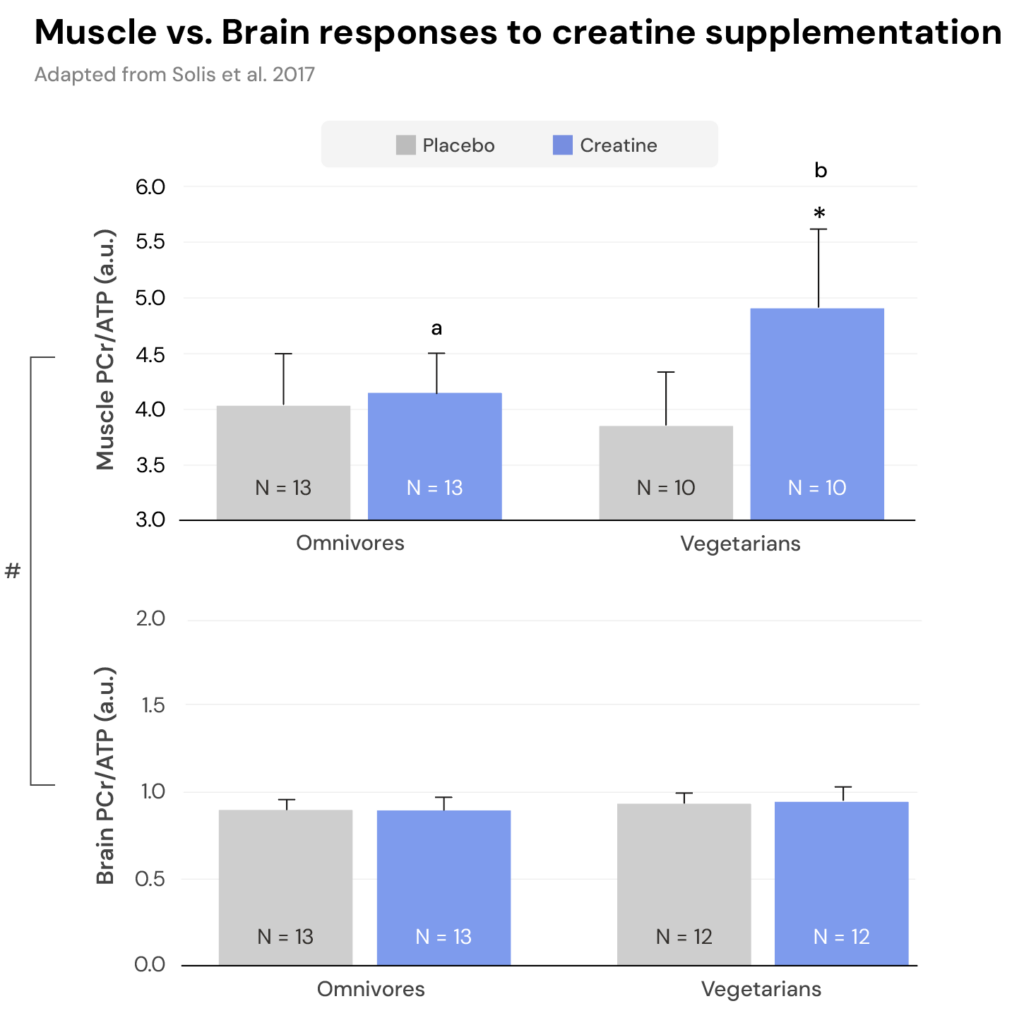
The researchers theorised the brain synthesises creatine from amino acids derived from dietary protein, rather than relying on dietary or supplemental creatine. This would explain why vegetarians don’t have lower brain creatine despite eating little to no dietary creatine.
Finally, it’s worth noting that while omnivores do consume more dietary creatine than vegetarians, neither group gets anywhere close to the recommended dose through food alone. Your body synthesises about 1g of creatine per day from amino acids. Omnivores get another ~1g from food (total: ~2g). Vegetarians get almost nothing from food (total: ~1g). To hit 5g from diet alone, you’d need to eat over 1kg (~2 lbs) of meat every day.
So, unless you want to become one of those annoying Carnivore diet bros and deepthroat steak all day long, supplementation is the only practical route for everyone—meat-eaters and vegetarians alike. The problem is that while creatine supplementation works brilliantly for muscle, the brain doesn’t seem to give a fuck.
All said, while vegetarians do respond better to creatine supplementation, that benefit is limited entirely to muscle and won’t do much for the brain.
Hm, ok, but can creatine benefit ageing brains?
As you age, cognitive abilities such as attention, memory, and executive function see a measurable decline, and the brain often needs more energy to keep up during complex tasks. Brain creatine stores are thought to decline with age as muscle creatine does, which would theoretically make supplementation more effective.
The problem, though, is that we don’t actually know whether the age-related decline in muscle creatine is due to ageing itself.
As Rawson and Venezia noted in their 2011 review: “It is unknown if muscle creatine declines with aging per se, or if this is a consequence of reduced physical activity and dietary creatine intake.” In other words, do older adults have lower creatine levels because of ageing or because ageing impacts the habits that would keep creatine levels topped up?
The second wrinkle in this theory is that when researchers measured brain creatine levels in young versus elderly adults, they found both groups had the same muscle creatine levels before supplementation. After supplementation, older adults showed a much larger increase in muscle creatine than young adults. But brain creatine didn’t change in either group (or in children, for that matter).

In their systematic review of creatine and cognition in ageing, Marshall and colleagues found that 5 of 6 studies reported positive effects, particularly on memory, attention, and processing speed.
Before you go and buy shares in a creatine company, the problem is the quality of the evidence. Half the included studies were rated “poor,” a third were “fair,” and only one was rated “good.”
More critically, four of the six were cross-sectional, meaning researchers measured how much meat people ate and then assessed their cognitive function. That’s correlation, not causation. People who eat more meat might also exercise more, earn more, have better healthcare and education. Three of the four cross-sectional studies failed to adequately adjust for these confounders, so you can’t tell if better cognition comes from creatine alone or from just being healthier and wealthier overall.
Strip away the observational data, and you’re left with just two intervention studies (i.e., studies that actually provided creatine to older adults and tested what happened), which were inconsistent.
In the first, McMorris and colleagues gave older adults 20g of creatine per day for one week and reported improvements in memory. In the second, Alves and colleagues provided 5g/day for 24 weeks and found no benefit.
Also, to close the loop from earlier, the review by Prokopidis and colleagues that found an effect in older adults after creatine supplementation? Here’s the kicker: these two studies—McMorris and Alves—were the entire older adult dataset in that review. One positive study lasting one week, and one null study lasting 24 weeks, were somehow averaged into effects being “more robust” despite 83% heterogeneity (which means the studies disagreed significantly).
So please excuse me if I remain deeply skeptical about creatine’s benefits for ageing brains.
Well, fuck, this is depressing–but I heard creatine can help during stress?
As noted earlier, creatine plays a role in supporting brain energy use by fueling all of the behind-the-scenes stuff that your brain does to help you think.
So, the theory goes, under heavy stress, the brain’s energy demands go up, and creatine could help provide a buffer for the extra energy you’re burning thinking about whatever deadline your boss is going to shout at you for if you miss it.
Except that there are a few problems with this idea.
First, the amount of energy your brain uses changes very little whether you’re lying quietly or actively engaged in a mentally demanding task. If you were lounging around and then suddenly decided to solve calculus problems because fuck it, why not? Your brain’s energy use increases by only about 5%. Compare that to the 20% of your total daily energy your brain burns running background operations, like firing neurons, inexplicably remembering every embarrassing thing you’ve ever done at 2 AM, and making sure you don’t forget to breathe now that you’re having a panic attack from said memories.
Second, a regular diet and your body’s own creatine production already provide enough energy for the brain to function just fine, and adding more creatine on top isn’t going to do much because there’s no shortage–it would be like trying to add more gas to your car when the tank’s already full.
Overall, the evidence is pretty weak that creatine can improve cognitive performance under general stress.
However, there may be one exception: sleep deprivation.
Could creatine help with sleep deprivation?
When you’re sleep-deprived, the brain burns through ATP faster than it can regenerate it. Since creatine increases phosphocreatine (your energy buffer; I already mentioned this, pay attention)–– theoretically, it could help when demand is high, and ATP is running low.
In a 2024 study, Gordji-Nejad and colleagues gave participants a massive dose of creatine (0.35g/kg—roughly 25g for a 70kg person) and kept them awake for 21 hours while measuring brain creatine changes with brain imaging.
Without creatine, memory worsened, cognitive speed and reaction time slowed, and fatigue increased by 172%. With creatine, cognition held up meaningfully better across the board.
The researchers speculated that the high creatine dose was effective because sleep deprivation induces an energy deficit in the brain. Under normal conditions, the brain tightly limits the amount of creatine it allows in, since stores are already full. But the metabolic stress from staying awake temporarily loosens that limit, allowing more creatine to enter.
While promising, it’s worth noting this is a single study, and further research is needed. Furthermore, really high doses of creatine could cause gastrointestinal distress (translation: you might shit your pants), and the potential benefits seem limited to sleep deprivation.
For everyday stress, creatine probably won’t help. But if you’re pulling an all-nighter or work in a job that requires staying awake for an extended period, creatine might buy you a few extra hours of decent cognitive function. Maybe.
Let’s wrap this up
To quickly recap everything we covered:
- For healthy young adults: If you eat meat and sleep reasonably well, studies don’t show reliable improvements in memory, focus, or thinking speed from creatine.
- Vegetarians: While vegetarians see a bigger increase in muscle creatine after supplementation, there doesn’t appear to be a unique benefit to cognition since vegetarians and meat-eaters have similar total brain creatine content.
- Ageing brains: Brain creatine levels don’t increase in older adults any more than in younger adults, and the two intervention studies examining this population found conflicting results. Most of the other research is observational, so it’s hard to know whether any cognitive benefits are due to creatine itself or to other lifestyle factors.
- Stress: Your brain only increases energy use by ~5% during demanding mental tasks, and your body’s natural creatine production is more than enough to cover it.
- Sleep deprivation: One study found that a large (~25g) dose of creatine helped people stay sharper and less tired after 21 hours of sleep deprivation. It’s promising, but very early, and high doses of creatine can cause gastrointestinal distress.
Here’s the reality: creatine’s brain benefits aren’t as exciting as social media makes them out to be. The research at this point just doesn’t support the hype.
That said, creatine supplementation remains the MVP for muscle and strength gains, with basically zero downsides. If you’re going to supplement with creatine, take it for those reasons.
I’ll end with a quote from a perspective paper:
Creatine’s proposed cognitive benefits remain under investigation, but public enthusiasm and commercial promotion have far exceeded the strength of the supporting evidence. The widespread amplification of preliminary or low-quality findings creates a distorted perception of efficacy that misleads consumers and undermines informed decision-making.
Thanks for reading. If you enjoyed this, you’d love the Vitamin

95% of my new content is only sent to my email list. One email every Thursday, filled with actionable, evidence-based fitness advice to help you with your goals. If you enjoyed this, you’ll love my emails. You can learn more and subscribe for free here.