A quick note before we begin: This article is written for generally healthy people. If you have a medical condition, like Addison’s disease or Cushing’s syndrome, where your cortisol situation is genuinely messed up, you should be talking to an endocrinologist, not reading some random article on the internet. If you are reading this and you have one of those conditions, I have questions about your life choices, but also, close this tab and call your doctor. For everyone else—the 99.9% of humans whose cortisol is doing exactly what it should be—this article is for you because the internet has convinced you that cortisol is a malevolent little fuckface actively preventing you from losing fat, and we need to talk about that.
Cortisol isn’t just the “stress hormone” – it plays several roles in the body that are essential for keeping us alive. It helps mobilise energy, moderates immune and inflammatory responses, consolidates memories, keeps the cardiovascular system in check, and even aids workout recovery. 1 2
Yet scroll through social media and you’d be forgiven for thinking cortisol is public health enemy number one–not only is it wreaking havoc on your body, which of course requires a special supplement, morning routine, or diet to fix, it’s also responsible for fat gain, weight-loss plateaus, and seemingly every body composition problem under the sun.
So, uh, what the fuck is going on here? Well, ‘the fuck’ is what we’re exploring in this article.
What’s the relationship between cortisol and fat gain?
When you chase down these claims, you quickly realise they’re drawn from animal experiments, mechanistic data, or extreme medical conditions (like Cushing’s syndrome). For example, a review of stress-related obesity notes that although animal models clearly link stress and the HPA axis (the brain–hormone circuit that controls cortisol release) to weight gain and metabolic disease, human studies “have proven to be more challenging, with more understated changes in the HPA axis.” 3
There is evidence that hair cortisol levels (a marker of long-term cortisol exposure) are higher in people with obesity compared to normal-weight individuals.
For instance, Jackson and colleagues conducted an observational study, finding that hair cortisol levels were positively associated with body weight, body mass index, and waist circumference. 4
However, a positive association doesn’t tell us much on its own. We also need to consider the strength of the association. In this case, it was very weak (and that’s being generous), accounting for only about 1% of the variation, suggesting that long-term cortisol exposure is as informative about weight gain as your star sign is for your next promotion.
More importantly, this type of observational research can’t prove causation, leading to a classic chicken-or-egg problem: Is cortisol causing the fat gain, or does existing fat gain (and the associated metabolic dysfunction) elevate cortisol? As one review paper put it: 3
In modern society, where overnutrition, sedentary lifestyle, and sleep deprivation are typical traits, chronic exposure to environmental stress potentially contributes to the development of obesity. This may be at least partially mediated through the HPA axis, although this relationship is complex and many factors, including genetic polymorphisms, tissue-specific cortisol metabolism, chronic inflammation, leptin, ghrelin, and sex hormones, influence the strength of this association.
In other words, shit is complicated and fat gain isn’t “the cortisol show.” It’s an ensemble cast of poor sleep, overeating, inactivity, genetics, hormones, stress, and everything in between.
The image below shows the complicated relationship between cortisol, obesity, and unhealthy lifestyle factors. The bidirectional arrows show that each element can both influence and be influenced by the others, highlighting why a simplistic take like “cortisol = fat gain” misses the forest for a shitty cortisol-drenched shrub.
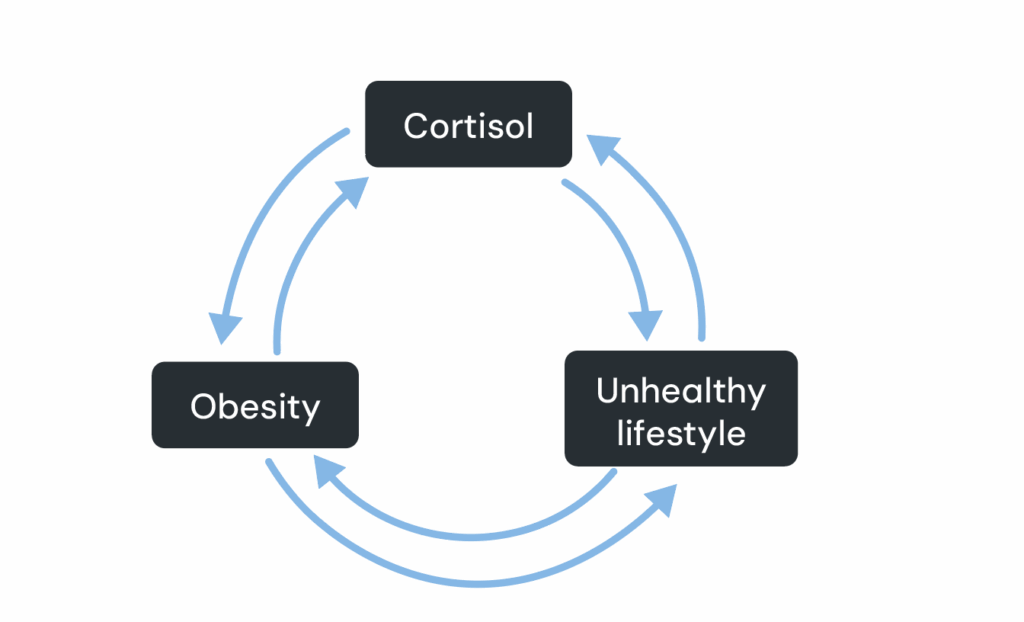
This complex relationship is why we don’t see a clear link between cortisol and weight gain.
Tenk and colleagues pooled data from 26 studies (encompassing ~1,500 adults) to see whether obesity or ageing consistently affected cortisol levels. 5 Their analysis found that body weight alone wasn’t a reliable predictor of cortisol levels, regardless of whether individuals were categorised as mildly, moderately, or severely obese. The only real link was a decline in cortisol levels with age in the obese group.
And a large cross-sectional study of obese and lean adults (with an accompanying literature review) noted “a lack of consistency in relationships between cortisol, weight, and metabolic parameters.” There was also no link between cortisol and health issues such as diabetes, high blood pressure, or metabolic syndrome. The researchers concluded, “These data raise doubts about the role of systemic cortisol in the development and maintenance of obesity and the metabolic syndrome.” 6
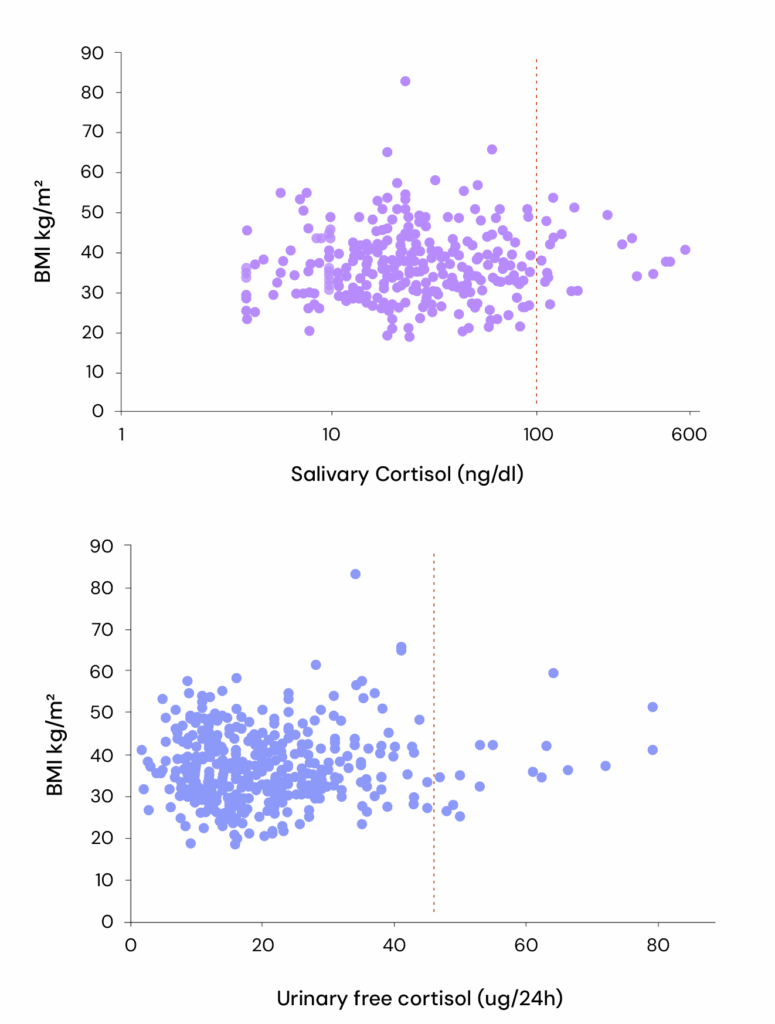
None of this should be surprising when you understand that regular day-to-day cortisol spikes don’t impact fat loss or gain. It’s only at abnormally high or low levels (like those seen in certain medical conditions) that cortisol becomes an issue. 7
Taking all of the above into account, cortisol isn’t the reason for fat gain. But what about the popular claim that cortisol can prevent fat loss – is there any truth to that?
Can cortisol stop fat loss?
You’ll often hear claims that chronically high cortisol “locks in” your body fat, making you resistant to a calorie deficit. In other words, it doesn’t matter how much you cut calories—you simply can’t lose fat if cortisol is running amok.
Hm, if only we had human research looking into this – oh wait, we do.
A systematic review and meta-analysis by Nakamura and colleagues found that increases in cortisol weren’t associated with how much weight people lost. Interestingly, fasting had a significant effect on cortisol levels, but low-calorie and even very low-calorie dieting (<800 calories/day) didn’t. In a separate analysis, the researchers found that cortisol levels spiked at the start of a diet but then drifted back toward baseline after several weeks, suggesting the body adapts over time. 8
And in the CALERIE-2 trial, non-obese men and women lost an average of 8.4 kg (approximately 11.5% of their body weight) at 12 months, during which cortisol levels increased by approximately 6%. By 24 months, despite still being 7.5 kg below baseline, cortisol levels had returned to normal. 9
But let’s set aside the research for a second and think about this logically: If elevated cortisol truly prevents fat loss, bodybuilders and physique athletes would be screwed. Yet, these individuals routinely achieve extreme levels of leanness—far beyond what most people will ever reach—during contest prep, regardless of what cortisol is doing.
The image below illustrates the percentage change in several hormones during a natural bodybuilder’s 6-month prep. His cortisol levels increased by over 100% during the prep, but he still dropped down to 4.5% body fat. 10
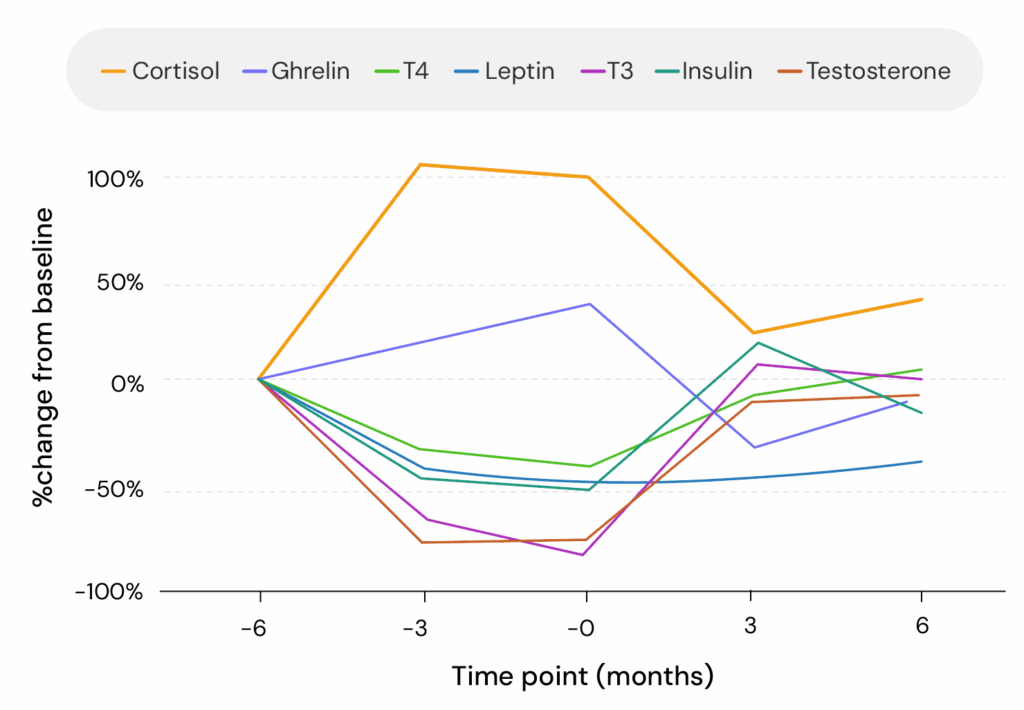
In contrast, a case study tracking a female physique athlete over six months of prep found no significant change in her cortisol levels despite losing 10 kg, halving her body fat % (from 30% to 16%), and dieting on ~1,000 fewer calories per day. 11
In short, the idea that your body will hold your fat hostage when cortisol is elevated just doesn’t pan out in research. In reality, chronic stress can make adherence to a deficit harder, but for other reasons we’ll get to later.
The relationship between cortisol and weight isn’t what you’d expect
If it were as simple as cortisol causes people to gain fat, we’d expect a straightforward relationship: the more body fat, the higher the cortisol, right? But it’s more complicated than that.
Schorr and colleagues examined cortisol levels across 60 premenopausal women spanning anorexia nervosa, normal weight, and overweight/obesity. Cortisol followed a clear U-shape: highest in very low BMI (anorexia), lowest in overweight/class-I obesity, and rising again with more severe obesity (though not to anorexia levels). 12
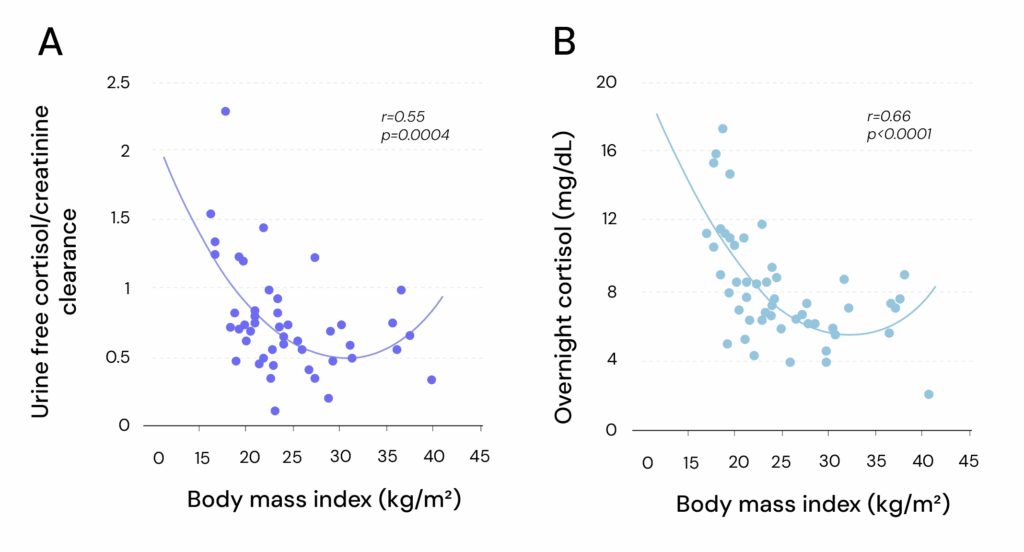
Adapted from Schorr et al.
Kumari and colleagues found the same U-shaped relationship in a much larger study of almost 4,000 men and women—both very low and very high BMIs were linked to poor cortisol patterns, while the healthiest cortisol profiles appeared in the middle ranges. 13
When taking all of this together, cortisol appears to be more of a marker of physiological stress at the extremes, rather than driving fat gain.
For example, a 2015 review paper notes that high cortisol levels in anorexia nervosa serve as an adaptive mechanism to maintain blood sugar and conserve energy for vital organs when energy availability is critically low. This is supported by an 8-week study conducted in US Army Rangers undergoing severe energy deficits (1,000-1,200 kcal/day). Their cortisol levels increased significantly only near the end of the study, when they had reached essential body fat levels. As the researchers put it, the cortisol response “may reflect the increased need to catabolize alternate body energy sources with the impending depletion of fat stores.”
On the flip side, research by Qi and colleagues found the opposite pattern in obesity. Individuals genetically predisposed to higher morning cortisol levels were less likely to have mild obesity, whereas more severe obesity was associated with lower morning cortisol levels. The researchers suggested this isn’t cortisol causing fat gain, but instead that obesity blunts the normal morning cortisol surge by disrupting the body’s daily rhythm.
This leaves us with a head-scratching paradox: if cortisol was causing fat gain, we should see the opposite pattern—low cortisol in very lean people and high cortisol in obese people. But we see the exact reverse. Cortisol is elevated in starvation states and suppressed in severe obesity.
Cortisol doesn’t affect weight maintenance either
Larsen and colleagues followed 786 people who had recently lost weight and found changes in hair cortisol had no significant link to regaining weight or body fat over the following year. 14
There was a small association between cortisol and day-to-day weight fluctuations, but this likely reflects temporary changes in eating patterns rather than cortisol driving long-term fat gain. For example, someone might eat more during a stressful work week, causing the scale to increase temporarily, but once the stress subsides and they return to their regular eating habits, the extra weight is lost without any lasting fat gain.
The real culprit: You. I mean, your behaviour
When looking at the entire body of research, one common thread emerges that explains how cortisol can impact weight and fat gain – behavioural change.
The circumstances that elevate cortisol make it more likely you’ll engage in behaviours that lead to a caloric surplus, and, if not remedied, could lead to fat gain over time. 15 Some examples include:
- Stress eating calorie-dense comfort foods
- Insufficient sleep disrupting appetite regulation
- Fatigue leading to reduced activity and skipped workouts
- Poor food choices when time and mental resources are limited
Kuckuck and colleagues reinforced this perspective in their review on stress, eating, and obesity, arguing that cortisol’s primary influence occurs through its effects on appetite-regulating hormones, such as leptin, insulin, ghrelin, and NPY. As a result, you’re more likely to feel hungrier, crave calorie-dense foods, and lose the normal satiety response that tells you you’ve eaten enough. 16
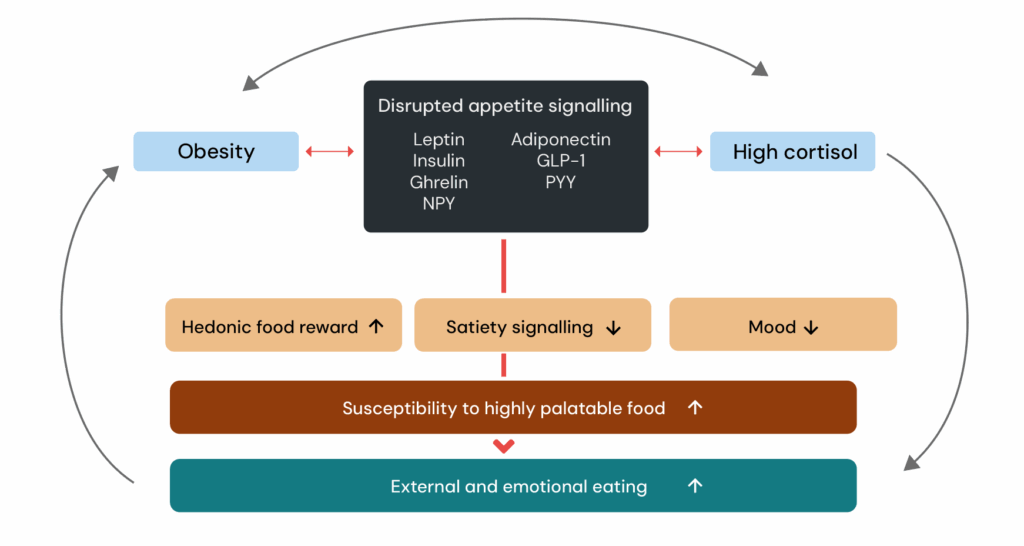
A 2024 systematic review by Rog and colleagues investigated whether chronic stress actually causes measurable changes in body weight and physical health measures. The majority of studies showed that chronic stress alone doesn’t significantly affect weight or metabolic markers in healthy people, whereas stress combined with unhealthy lifestyle habits (such as poor diet and lack of exercise) does. 17
Lastly, I want to point out that high stress doesn’t necessarily mean people eat more, nor is it the harbinger of fat gain.
A comprehensive review of 54 studies (~120,000 adults) found that stress had a small, positive effect on increasing food intake, and nudged people toward eating more unhealthy foods and fewer healthy foods. However, the effects were modest and varied significantly between individuals. 18 This is likely why stress is associated with fat gain, but the effect is tiny. 19
Chill out about cortisol
Every day stress responses won’t block fat loss if you’re in a caloric deficit. So, it’s not cortisol alone that causes fat gain, but the behaviours that accompany stress.
This is actually good news. It means you don’t need expensive “cortisol-blocking” supplements, special “cortisol diets,” or whatever other bullshit social media is trying to sell you.
Instead, focus on the things that can actually help:
- Manage your stress levels through whatever works for you—meditation, walks, hobbies, therapy.
- Prioritise sleep–yes, that might mean skipping the third episode of whatever shitty Netflix show you’ll forget about in a week.
- Stay active even when things are busier than usual—light movement beats nothing. Better yet, going out for a walk in nature (you know, that big green place you scroll past on Instagram) could help reduce stress. 20
- Be aware of stress eating patterns without demonising them, and try to find healthier replacements.
The next time you see someone claim cortisol is sabotaging your weight loss goals, you can confidently call bullshit. And if that same someone is selling you a secret solution ‘they’ don’t want you to know, run the other way because the solution isn’t some overpriced cortisol supplement–it’s addressing the real issue. Manage your stress, prioritise your sleep, stay consistent with your habits, and stop looking for hormonal scapegoats. Your behaviours under stress matter infinitely more than your cortisol levels, and thankfully, you have control over your behaviours. Take care of that, and cortisol will take care of itself.
Thanks for reading. If you enjoyed this, you’d love the Vitamin
95% of my new content is only sent to my email list. One email every Thursday, filled with actionable, evidence-based fitness advice to help you with your goals. If you enjoyed this, you’ll love my emails.
Subscribe for free below or Learn more about the Vitamin