This week: A new study investigated whether using artificial sweeteners after weight loss was better for weight maintenance and health compared to a healthy low-sugar diet. In contrast to previous research, which has mostly focused on weight loss, this study is the largest and longest to look at the effects of artificial sweeteners on weight maintenance.
I first wrote about artificial sweeteners back in 2017 (yeah, I’ve been doing this for a minute), and almost a decade later, study after study has only further cemented what I said in that article: Artificial sweeteners don’t appear to be detrimental to our health (I say ‘our’ health because the study that caused all the hysteria used rats).
However, most research on artificial sweeteners focuses on weight loss. But what about weight maintenance? I mean, if you don’t fuck around, you could be done with the weight loss part within a few months, but maintaining your new body weight is a lifetime commitment. So any strategy that lets you cut calories without giving up sweet foods and drinks can make the process considerably easier.
Furthermore, you’ll find artificial sweeteners in everything from soft drinks to yoghurt, snacks and supplements, not just zero-calorie beverages.
So the question is: Do artificial sweeteners help with weight maintenance when consumed regularly across the diet?
That’s the question a recent study wanted to answer.
Let’s talk about that.
The SWEET trial: testing artificial sweeteners impact on weight maintenance
The SWEET trial (the cute name for the study) recruited 341 adults* with overweight and obesity from Denmark, Greece, Spain, and the Netherlands for a year-long randomised-controlled trial consisting of two phases:
(*The study also included 38 children but the sample was too small to draw any real conclusions from, so I’ll be focusing on the adults).
Phase 1: All participants followed the same low-energy diet with the goal of losing at least 5% of their body weight. 277 of the initial 341 participants achieved this goal, losing an average of ~10kg.
Phase 2: Participants were randomised into two groups for 10 months:
- Sweeteners and Sweetness Enhancers Group (S&SE): Healthy diet, low in added sugar (<10% of calories), but allowed to use sweeteners and sweetness enhancers in foods and drinks.
- Sugar Group: Same healthy, low-sugar diet, but no sweeteners allowed. They could use regular sugar within their allowance.
Other than the above guidelines, participants were instructed to eat ad libitum (i.e., as much as they wanted).
Researchers were primarily interested in changes in body weight and gut microbiota composition, but they also looked at cardiometabolic markers, adverse events, and GI symptoms.
So, do artificial sweeteners help maintain weight loss?
Weight maintenance
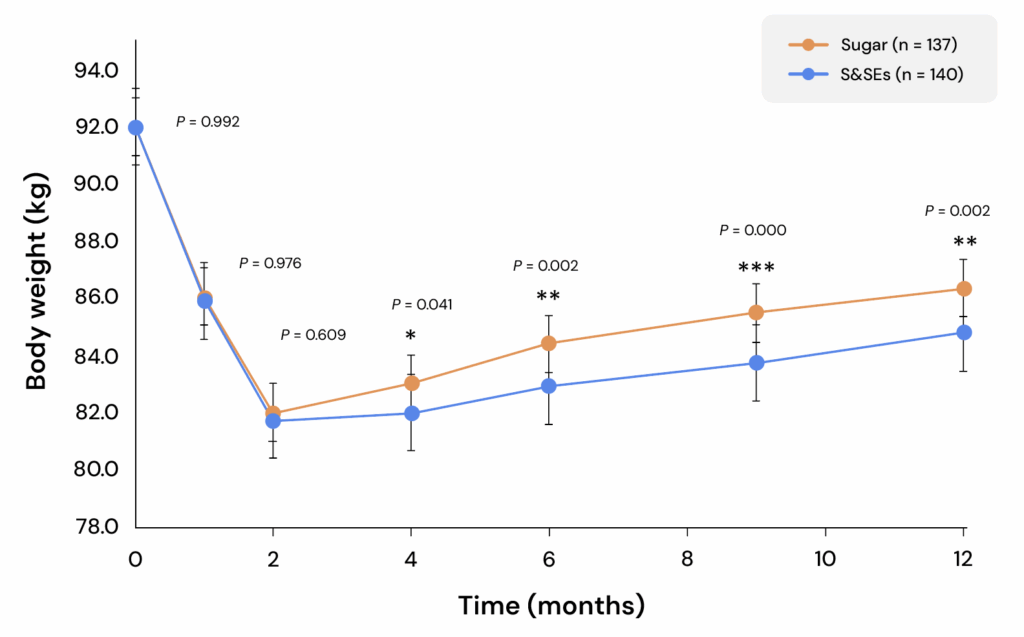
Across both groups, the average weight change from baseline was –6.4 kg. However, if we dive deeper into the data:
- Comparing maintenance diets: The S&SE group kept off about 1.6–1.8 kg (~3.5-4 lbs) more than the sugar group over 1 year.
- At several time points (4, 6, 9, 12 months), the S&SE group consistently weighed ~1–2 kg (~2-4 lbs) less than the sugar group (see image below).
- Among people most adherent to the assigned diet, the gap in weight maintenance increased (up to ~3.8 kg or 8.3 lbs) in favour of the S&SE group.
Gut health
This is where you might expect the bad news if you believe some of the claims made online. But there isn’t any.
In fact, quite the opposite. They actually saw increases in bacteria that produce short-chain fatty acids (SCFAs). These are the “good guys” that keep your gut lining healthy, aid satiety, and have anti-inflammatory effects.
Overall, consuming artificial sweeteners didn’t harm gut bacteria or gut health.
Cardiometabolic health
Most cardiometabolic measures (glucose, insulin, cholesterol, blood pressure) were similar between groups, with a few minor improvements early on for the sweetener group.
Side effects
The sweetener group reported more gas, loose stools and cramps, likely due to how certain sweeteners ferment in the gut.
For example, sugar alcohols (polyols like sorbitol, xylitol, erythritol, and so on) are poorly absorbed in the small intestine, and depending on the dose, can cause things like abdominal discomfort, bloating, and diarrhoea in both healthy people and those with IBS.
However, at moderate doses, sugar alcohols are generally fine, and some, like erythritol, are better tolerated than others. But if you plough through a bag of sugar-free gummies, then well, you’re asking for a shit time.
Ok, so what?
Using (zero-calorie) sweeteners as part of a healthy, low-sugar diet helped people maintain their weight long-term, without harming their gut or metabolic health.
Oh, and this wasn’t some tiny pilot study either. It’s the largest trial on sweeteners to date, with 379 participants across four European sites.
Now, the study enrolled adults with overweight or obesity, so technically, that’s who the results apply to. But the underlying principle — replacing sugar with low- or no-calorie alternatives means fewer calories — is still relevant to everyone.
In practical terms, swapping sugary drinks for zero-sugar versions is the obvious one. One study even found that low-calorie sweetened drinks led to slightly more weight loss than water alone. The difference wasn’t huge, but it does show that these drinks aren’t metabolic saboteurs, as some corners of the internet like to claim.
Beyond drinks, you can apply the same logic to yoghurts, cereals, jams, desserts, and chocolate — anywhere sugar is adding calories you don’t need.
Will these swaps cause dramatic weight loss on their own? No. But they make sustained calorie control slightly easier without requiring you to give up sweet things entirely.
This study also busts some of the myths about artificial sweeteners that circulate online.
For example, if artificial sweeteners increased appetite and made you eat more, we would have seen the sweetener group regain more weight. But they regained less weight over 10 months.
If artificial sweeteners harmed your gut microbiome, we would have seen that happen in this study, but the sweetener group developed more SCFA-producing bacteria, which are associated with better metabolic health.
Additionally, there was no difference in fasting glucose or insulin levels to suggest that sweeteners impaired glucose regulation. So no, artificial sweeteners don’t “spike insulin.”
If you’re wondering why there seems to be so much conflicting evidence around artificial sweeteners, a 2021 paper provides an explanation.
The researchers conducted a citation network analysis (basically mapping which studies each review chooses to cite to see how that shapes their conclusions) and found that “reviews concluding a beneficial relationship of LES [low-energy sweeteners] with body weight cite mainly randomised controlled trials, whereas reviews concluding an adverse relationship cite mainly observational studies.”
In other words, it’s not the evidence that’s contradictory. Rather, the conclusions depend on the type of study the review leans on.
People who are already overweight might switch to diet drinks in an attempt to control their caloric intake and lose weight. Someone at risk of diabetes might replace sugary foods and beverages with diet or zero-calorie alternatives.
So was it the artificial sweeteners that caused the problems, or did pre-existing issues push people to start using artificial sweeteners?
Observational studies can’t answer that question, which is why randomised controlled trials (RCTs) are better.
In an RCT, researchers have a bit more control over variables. So if both groups start out similar and the sweetener group ends up worse off (in whatever metric the study is evaluating), you can be a bit more confident that the sweeteners might have played a role.
However, a single study can’t tell us much on its own. One RCT on a single group of people, run for a specific duration, tells you only so much.
This is where systematic reviews and meta-analyses come in. Instead of relying on a single study, researchers pool data from dozens of trials—across different people, durations, and settings—to see the overall pattern.
And when you look at that body of evidence, artificial sweeteners are totally fine when consumed in any reasonable amount.
For example, the latest review on the topic investigated whether artificially sweetened drinks affect metabolic risk factors (such as body weight, blood glucose, cholesterol, and blood pressure) compared with unsweetened beverages, such as water or tea.
The key finding was that there was no significant difference between the two.
Whether people drank diet drinks or stuck to water, it didn’t meaningfully change their weight, blood sugar, insulin resistance, cholesterol, blood pressure, or even how much they ate. In other words, artificially sweetened drinks were metabolically neutral.
Bottom line
This is the largest, longest real-world trial on sweeteners we have. It used foods and drinks, and followed people for a whole year in a realistic dietary context, and found that consuming artificial sweeteners as part of a healthy, low-sugar diet helped people keep more weight off without any harm to metabolic or gut health.
If you enjoy sweet foods and drinks, using artificially sweetened versions instead of sugary alternatives is a reasonable strategy for reducing calorie intake and maintaining weight loss.
Related articles:
Thanks for reading. If you enjoyed this, you’d love the Vitamin

95% of my new content is only being sent to my email list. One email every Thursday, filled with actionable, evidence-based fitness advice to help you with your goals. If you enjoyed this, you’ll love my emails. You can learn more and subscribe for free here.